Medal of Honor

Medal of Honor

Friday, November 5, 2010

Coxswain Claus Kristian Randolph Clausen (1869 – 1958)


Claus Kristian Randolph Clausen (December 9, 1869 – December 23, 1958) was an enlisted man and later an officer in the United States Navy. He received America's highest military decoration - the Medal of Honor - for actions in the Spanish-American War.
Claus Kristian Randolph Clausen was born on December 9, 1869 in Denmark. Later enlisting in the Navy from the state of New York, he served on the USS New York during the Spanish American War as a Coxswain. He was one of eight volunteer crew members of the collier USS Merrimac, which Rear Admiral William T. Sampson ordered sunk to block the entrance of Santiago Harbor, Cuba. On the night of 2-June 3, 1898, during the attempt to execute this mission, Merrimac's steering gear was disabled by enemy gunfire, and she sank without obstructing navigation. Her crewmen were rescued by the Spanish and made prisoners-of-war. After the Battle of Santiago de Cuba destroyed the Spanish fleet a month later, Clausen and his shipmates were released. For his "extraordinary heroism" during this operation, he was awarded the Medal of Honor.
Clausen was promoted to the Warrant Officer rank of Boatswain on July 30, 1903. As an officer, his initial assignment was on the cruiser USS Detroit, operating in the Caribbean. Following this sea duty, he served two years on the New York Navy Yard's receiving ship USS Hancock. Boatswain Clausen's next time at sea was on the battleship USS Mississippi from 1908 to 1911. On July 30, 1909, while on Mississippi, he was promoted to Chief Boatswain. After another tour at the New York Navy Yard, from 1911 to 1914, Chief Boatswain Clausen obtained the special qualification of a "Master's License under Steamboat-Inspection Service" before reporting on board battleship USS New Jersey. He served in her during World War I and received a temporary promotion to Lieutenant, Junior Grade in May 1917.
After the war, Clausen transferred back to the New York Navy Yard and, in 1920, reverted to Chief Boatswain. His next shipboard assignment was as an officer of USS Florida. In November 1922, he transferred to the Naval Torpedo Station, Newport, Rhode Island and three months later reported on board the receiving ship USS Colorado (ACR-7) at New York. Chief Boatswain Clausen was placed on the retired list on November 15, 1925. Though retired, he was promoted to Lieutenant in June 1930, but again reverted to Chief Warrant Officer 4 in the early 1950s. He lived his later years in Massapequa Park, New York, and at his death was the last surviving Medal of Honor recipient from the Spanish American War. Claus K. R. Clausen died on December 23, 1958 at St. Albans, New York and is interred in the U.S. Columbarium, Middle Village, New York.
Medal of Honor citation
Rank and organization: Coxswain, U.S. Navy. Born: December 9, 1869, Denmark. Accredited to: New York. G.O. No.: 529, November 2, 1899.
Citation: In connection with the sinking of the U.S.S. Merrimac at the entrance to the harbor of Santiago de Cuba, 2 June 1898. Despite heavy fire from the Spanish batteries, Clausen displayed extraordinary heroism throughout this operation.

GM1 George Charrette (1867 - 1938)


George Charrette (June 6, 1867 – February 7, 1938) was an enlisted man and later officer in the United States Navy who received the Medal of Honor for his heroism during the Spanish-American War.
Charrette was born in Lowell, Massachusetts on June 6, 1867. He enlisted in the United States Navy September 24, 1884. As a Gunner's Mate third class, on June 2, 1898, he volunteered with seven others to sink USS Merrimac under heavy Spanish fire across the entrance to the harbor of Santiago, Cuba, thus bottling up the enemy fleet. Taken prisoner by the Spanish, Charrette was exchanged July 6, 1898. He was awarded the Medal of Honor for extraordinary heroism, although his name was misspelled as George Charette on the citation. Charrette was commissioned lieutenant on August 3, 1920, and retired from the Navy in 1925. He died February 7, 1938 in Lowell, Massachusetts and was buried in Arlington National Cemetery, Arlington County, Virginia.

Medal of Honor Ctation

Rank and organization: Gunner's Mate First Class, U.S. Navy. Entered service at: Lowell, Mass. Born: 6 June 1867, Lowell, Mass. G.O. No.: 529, 2 November 1899. Citation: In connection with the sinking of the U.S.S. Merrimac at the entrance to the harbor of Santiago de Cuba, 2 June 1898. Despite heavy fire from the Spanish batteries, Charette displayed extraordinary heroism throughout this operation.

Wednesday, November 3, 2010

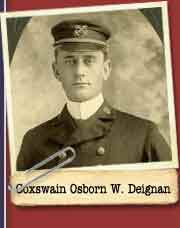
Seaman Osborn Warren Deignan (1873 – 1916)


Osborn Warren Deignan (February 24, 1873 – April 16, 1916) was an enlisted sailor and later a Warrant Officer in the United States Navy. He received his country's highest military decoration—the Medal of Honor—for actions in the Spanish-American War. Born in Iowa, he joined the Navy in 1894 and participated in the Battle of Santiago de Cuba, the largest naval engagement of the Spanish-American war. Deignan and seven others attempted to block the entrance to Santiago Harbor, Cuba but the Spanish destroyed their ship before they could accomplish their mission, and took them prisoner. The men were later released and Deignan received the Medal of Honor for his actions. He went on to become an officer and served in various posts and ships throughout the Navy until retiring in 1906. He died in Colorado in 1916, and was buried in California.
Deignan was born February 24, 1873 (as per first Navy enlistment record dated December 7, 1894) near Stuart, Iowa to John Deignan and his wife. His father had also been a sailor, serving in the Navy during the American Civil War, and afterwards went to work for the Rock Island Railway as a conductor. When Osborn was five years old, a torndado struck his father's train in Grinnel, Iowa, killing him and leaving Osborn, his mother and his brother to survive on their own. His mother remarried and the family, along with two additional children from his new stepfather, moved to North Tremont Street in Stuart. In 1887 he left school and went to sea, serving on ships in the Atlantic ocean, the Arctic and the Caribbean.
Deignan enlisted in the United States Navy from his home state of Iowa, originally on December 7, 1894 (as per first Navy enlistment record). He served on numerous USN vessels between 1894 and 1896 and, having deserted from the USS Newark on May 6, 1896 (as per naval records maintained by the Military Record Center) then re-enlistment in 1898 (as per naval records maintained by the Military Record Center.) He was assigned as a Coxswain to the USS Merrimac (1898) during the Spanish-American War. The Merrimac had frequent problems with the steering and engines, and Deignan referred to it as "cranky". After a short time on the ship, he garnered a reputation as an able helmsman and was preferred when delivering coal to the other ships in the fleet, a task that could be difficult in a ship that was already hard to control.
When Rear Admiral William T. Sampson requested volunteers for an extremely dangerous mission, there were more than enough volunteers, but he chose Osborn as the helmsman. The mission was to sink Merrimac at the entrance to Santiago Harbor, Cuba in an effort to block it and pen the Spanish Navy in the harbor. Seven other members of the crew were also chosen for the assignment. While the crew was attempting to fulfill its mission, Spanish forces fired on the ship and, in the process, disabled the Merrimac's streering controls before the crew could complete their task. The ship sank without obstructing navigation, but the crew was able to escape the ship before she went under. They were rescued by the Spanish and were taken as prisoners-of-war. A month later the Spanish fleet was destroyed at the Battle of Santiago de Cuba and the crewman were released. For his "extraordinary heroism" during the operation, Deignan was awarded the Medal of Honor.
On April 9, 1900, Deignan was promoted to the Warrant Officer rank of Boatswain. As an officer, his initial assignments were in the Philippines, first at Manila, then at the Naval Station, Cavite. After meeting her at a party in 1898, he married Maud Huntoon on May 14, 1902 and together they had a daughter. In June 1902, he reported for duty on the USS Oregon (BB-3) and later that year transferred to the receiving ship USS Independence (1814), at the Mare Island Naval Shipyard, California. He was stationed at Navy Yard, Pensacola, Florida, from 1903 through 1904, and then was assigned to the receiving ship USS Franklin (1864), at Norfolk, Virginia. He remained there for less than a year before reporting for his last tour of duty on the monitor USS Amphitrite (BM-2) in April 1905. He retired on April 21, 1906 and moved to the Los Angeles, California area.
Deignan died April 16, 1916 in Cannon City, Colorado at the age of 43 (based on birth in 1873) and was buried with full military honors at Forest Lawn Memorial Park, Glendale, California. His grave can be found in the Whispering Pines section, L-1165. Post #1842 of the Veterans of Foreign Wars was named in his honor.
Medal of Honor Citation
Rank and organization: Coxswain, U.S. Navy. Born: 24 February 1873, Sheart, Iowa. Accredited to: Iowa. G.O. No.: 529, 2 November 1899. Citation: In connection with the sinking of the U.S.S. Merrimac at the entrance to the harbor of Santiago de Cuba, 2 June 1898. Despite heavy fire from the Spanish batteries, Deignan displayed extraordinary heroism throughout this operation.

First Lieutenant Willibald C. Bianchi (1915 − 1945)


Willibald C. Bianchi (March 12, 1915 − January 9, 1945) was an officer in the Philippine Scouts who received the Medal of Honor for actions in Bataan, Philippines during that country's capitulation to Japanese forces during World War II. After the action near Bagac in the Bataan Province, Bianchi was among the troops captured by the Japanese at the fall of Bataan,on April 9, 1942. He was part of the Bataan "Death March," and was imprisoned in several Japanese prisoner of war camps, enduring horrible conditions. He was known for his compassion and efforts to better the lot of his fellow prisoners by bartering with their captors for extra food and medicine. On January 9, 1945, while imprisoned in an unmarked Japanese prison ship, Bianchi was killed instantly when an American plane, unaware that the ship contained American prisoners, dropped a 1,000-pound bomb in the cargo hold. Bianchi is one of three members of the Philippine Scouts who were awarded the Medal of Honor.
Medal of Honor Citation:

Bianchi, Willibald C. Rank and organization:First Lieutenant, U.S. Army, 45th Infantry, Philippine Scouts Place and date:Near Bagac, Bataan Province, Philippine Islands, February 3, 1942. Entered service at:New Ulm, Minnesota. Born:New Ulm, Minnesota
For conspicuous gallantry and intrepidity above and beyond the call of duty in action with the enemy on 3 February 1942, near Bagac, Province of Bataan, Philippine Islands. When the rifle platoon of another company was ordered to wipe out 2 strong enemy machine gun nests, 1st Lt. Bianchi voluntarily and of his own initiative, advanced with the platoon leading part of the men. When wounded early in the action by 2 bullets through the left hand, he did not stop for first aid but discarded his rifle and began firing a pistol. He located a machine gun nest and personally silenced it with grenades. When wounded the second time by 2 machine gun bullets through the chest muscles, 1st Lt. Bianchi climbed to the top of an American tank, manned its antiaircraft machine gun, and fired into strongly held enemy position until knocked completely off the tank by a third severe wound.

Tuesday, November 2, 2010

Woodrow Wilson Keeble (1917 – 1982)


Master Sergeant Woodrow Wilson Keeble (May 16, 1917 - January 28, 1982) was a U.S. Army National Guard veteran of both World War II and the Korean War. He was a full-blooded member of the Sisseton Wahpeton Oyate of the Lake Traverse Reservation, a Sioux Native American tribe.
Following a long campaign by his family and the congressional delegations of both North and South Dakota, on March 3, 2008, President George W. Bush posthumously awarded Keeble the Medal of Honor for his actions in the Korean War. Keeble had previously been awarded the Distinguished Service Cross, the Silver Star, the Bronze Star with V device for Valor, the Bronze Star for merit, and the Combat Infantryman Badge (first and second awards). Although he was wounded at least twice in World War II and three times in Korea, he received only two Purple Hearts.
Woodrow Keeble was born in Waubay, South Dakota to Isaac and Nancy (Shaker) Keeble on May 16, 1917. While still very young, he moved to Wahpeton, North Dakota, where his mother worked at the Wahpeton Indian School (now called Circle of Nations School). Unfortunately, Nancy died when Keeble was still a child. Keeble's father, who was too impoverished to feed his family, permanently enrolled Woodrow and his siblings in the school.
Woodrow excelled in athletics, especially baseball, and pitched the Wahpeton amateur team to ten straight victories. He was being recruited by the Chicago White Sox when his Army National Guard unit was called up to serve in World War II.
In World War II, Keeble served with I Company of the famed North Dakota 164th Infantry Regiment. After initial training in Louisiana, the regiment carried out various orders in several West Coast locations before being deployed to Australia in preparation for operations in the Pacific Theater. Keeble's unit was assigned to the Americal Division.
The 164th landed on Guadalcanal on October 13, 1942 to help the battered First Marine Division, which had suffered heavy losses while clearing the South Pacific island of Japanese. The 164th provided the first replacements for the 1st Marines, and although the new boys were green, the exhausted men heartily welcomed the North Dakotans—and their supplies.
Keeble's regiment of Dakotans was the first United States Army unit to conduct an offensive operation against the enemy in any theater.
Largely because of transport constraints, the Americal Division arrived on Guadalcanal piecemeal, and was fed into combat alongside the battle-hardened Marines. Thus, in contrast to how several US Army divisions were deployed in the Pacific War, the soldiers of the 164th Infantry were able to learn the practical art of jungle warfare against the Japanese without suffering as many casualties as might otherwise have occurred.
The battles on Guadalcanal were some of the most brutal of the war. Japanese troops adopted the Banzai charge, wildly attacking in human waves. Sometimes the hand-to-hand battles would last all through the night.
During these battles, Keeble's reputation for bravery and skill grew. Nearly a head taller than most of his fellow soldiers, he was an expert with the Browning Automatic Rifle (BAR). His other great weapon was his pitching arm, which he used to hurl hand grenades with deadly accuracy. James Fenelon, a member of the Standing Rock Sioux Tribe of North & South Dakota who fought with Keeble on Guadalcanal, once remarked, “The safest place to be was right next to Woody.”
Despite its ad-hoc formation, the Americal Division fought well at Guadalcanal, the 164th taking on a key role in the defeat of a major Japanese offensive in October 1942. Uniquely, the North Dakotans performed so heroically on Guadalcanal in support of the Marines that they received a Navy Presidential Unit Citation.
After the battles on Guadalcanal, Keeble and the rest of the regiment participated in combat campaigns on the islands of Bougainville, Leyte, Cebu, and Mindanao. Following the Japanese surrender, the entire Americal Division landed in Japan and took part in the occupation of the Yokohama region.
After the war, Keeble returned to Wahpeton and worked at the Wahpeton Indian School. On November 14, 1947, Woodrow Wilson Keeble married Nettie Abigail Owen-Robertson (b. March 30, 1917).
Woodrow Keeble on combat
Examining the experience of being in combat for the first time, Keeble explained,
Before I experienced the horror of that attack, I was quick to call coward or yellow anyone who showed fear under any circumstances. Nevermore. I don’t know these things, but they speak truth to one. I am not a psychologist, nor a statistician, and less of a philosopher; but the depth of emotion, the dreads of fear, the referees of horrors, and the concentration of self that led me to make this observation, the fear impulse, or perhaps, better said, the (impulses caused) by fear, are stronger, more demanding than either that of love or hunger...
He also wrote:
Fear in my opinion is a state of drunkenness. And when men are in that state when the fear impulse takes a hold...he loses all reason, sense of values, and is not liable, or at least should not be held accountable for acts perpetrated when thus possessed.
Keeble continued:
During the 13 months (in the) almost continual and sustained combat in which I have ever participated, there were moments, and rare ones, I am sure; but they lose none of their terror or horror for which fear laid a relentless and a powerful hold on me, that the pull of cowardice was almost more than I could ward off. There were terrible moments that encompassed a lifetime, an endlessness, when terror was so strong in me, that I could feel idiocy replace reason. (Yet,) I have never left my position, nor have I shirked hazardous duty. Fear did not make a coward out of me.
The 164th Infantry Regiment was reactivated in 1951 during the Korean War; they trained at Camp Rucker, Alabama. When Keeble's commanding officer, Lt E. Duane Holly, had to select several sergeants for deployment to the front lines, he decided to have his men draw straws. Keeble volunteered instead. Asked why, Keeble said, “Somebody has to teach these kids how to fight.”
Keeble was assigned to George Company, 2nd Battalion, 19th Infantry Regiment, 24th Infantry Division. His combat experience and a genuine gift of leadership brought him a quick series of promotions to the level of master sergeant, leading the 1st Platoon.
The summer and fall of 1951 were particularly deadly for both sides as the war moved into its second year. The 24th Division was in the central area of the Korean peninsula when, on October 13, 1951, the Division was called upon to take a series of steep mountains protecting a major Chinese supply depot in the town of Kumsong.
This push, Operation Nomad-Polar, was to be the last major United Nations offensive of the war.
Keeble, described as a gentle giant by his friends, was a ferocious warrior in battle, as evidenced by his heroic actions over the next six days. Official records confirm Keeble was initially wounded on October 15, and then again on October 17, 18 and 20 - for which he received only one Purple Heart. For his bravery on the 18th, he was awarded a Silver Star. His heroism on the 20th made Keeble a legend - and 57 years later resulted in his posthumous Medal of Honor.
George Company was in its sixth day of round-the-clock fighting. They were facing deeply entrenched Chinese soldiers on Hill 675-770, the last major Chinese stronghold between the UN forces and Kumsong. Keeble had thus far suffered two rifle wounds to his left arm, a grenade to his face that almost removed his nose and a badly twisted knee; on the 19th, doctors reportedly removed 83 pieces of festering shrapnel Keeble had sustained from a concussion grenade the previous day. On the 20th, Medic Dale Selby told Keeble he should stay back because of his wounds, but Keeble refused to let his men go up the mountain without him. That day, Master Sergeant Keeble single-handedly destroyed three enemy machine-gun bunkers and killed an additional seven enemy soldiers in nearby trenches.
His bravery in the face of enemy fire was so remarkable that a recommendation that he receive the Medal of Honor was twice submitted. In both cases, the recommendation was lost. When Keeble's men endeavored to submit the recommendation a third time, officials informed them they were too late; they were told regulations prevented them from submitting another recommendation.
Master Sergeant Keeble returned to North Dakota after the Korean War and again worked at the Wahpeton Indian School. Soon after, he was afflicted with tuberculosis, which required that he undergo long-term treatment in Minneapolis, Minnesota. Surgeons ultimately removed one of his lungs, which triggered a series of strokes that rendered him speechless, partially paralyzed and unable to work for the remainder of his life. Nettie, his wife of 14 years, died the following year, leaving Keeble to raise their young son, Earl, alone.
Keeble fell on hard times and is said to have pawned his medals. Nevertheless, and despite his disabilities, Keeble persevered. In 1967, he married Blossom Iris Crawford-Hawkins (b. July 18, 1926), the first Sioux woman to complete a Doctorate of Education, (including doctoral dissertation).
Woodrow Keeble was a member of the Veterans of Foreign Wars (VFW) Post 4324 - Wahpeton, ND.
Woodrow W. Keeble died January 28, 1982, and is buried in Sisseton, South Dakota. On May 17, 2008, his tombstone was replaced with a Medal of Honor headstone.
Medal of Honor campaign
Keeble's family and friends remained dedicated to efforts to get him the Medal of Honor for which he was twice recommended. United States Senators Byron Dorgan (D-N.D.), Kent Conrad (D-N.D.) John Thune (R-S.D.) and Tim Johnson (D-S.D.) long urged that Keeble be posthumously awarded the Medal of Honor.
Senator Conrad and North Dakota Adjutant General Michael Haugen presented Keeble's family with a duplicate set of his medals on May 30, 2006, at the Wahpeton Armory. Moments before the event was to begin, word came that Secretary of the Army Francis Harvey was recommending Keeble's Distinguished Service Cross be upgraded to the Medal of Honor. From there, Keeble's case moved up to the level of Secretary of Defense.
In 2007, Secretary of Defense Donald Rumsfeld, notified the four Dakota Senators that a statute of limitations would prevent the Medal of Honor to be granted. The four Dakota Senators immediately drafted legislation to remove the last barrier to the posthumous awarding of the honor.
In May 2007, the congressional funding bill for Iraq included language to grant a waiver of the statute of limitations for awarding a Medal of Honor to Woodrow W. Keeble, enabling the President to sign off on the recommendation, dependent on the Secretary of Defense's recommendation for the upgrade. President Bush signed the legislation on May 24, 2007.
Senator Thune issued a statement on June 2 that read, in part,
Master Sergeant Woodrow W. Keeble served with bravery and dignity, going beyond the call of duty not for notoriety or recognition-but for the mission he believed in and the country he loved. Keeble's legacy is a great source of pride for his family, his fellow Dakota Sioux, and all Americans. The Secretary of the Army's recommendation is wonderful and long-awaited news. I began working with Master Sergeant Keeble's family and tribal officials on resolving this long overdue issue in the spring of 2002, and I will continue to work with Defense officials to ensure that this legendary soldier receives the final and most distinguished honor he deserves.
Senator Johnson urged Secretary of Defense Robert M. Gates to act quickly on the recommendation. “... it is my hope that both you and the President can move forward on Master Sergeant Keeble’s case as expeditiously as possible,” Johnson said in a letter to Gates quoted in the Argus Leader of Sioux Falls, South Dakota.
It would be another year before the President would finally award the Medal of Honor to Keeble. Despite failing health, Blossom Keeble was determined to live long enough to accept the Medal of Honor on her husband's behalf. Unfortunately, she died quite suddenly on June 3, 2007 before the honor became a reality.
In February 2008, the White House announced that Keeble would receive the Medal of Honor posthumously in a ceremony scheduled for March 3. "We are just proud to be a part of this for Woody," Keeble's stepson Russell Hawkins said in a U.S. Army announcement. "He is deserving of this, for what he did in the Armed Services in defense of this country."
Hawkins added that this victory is as important for the Sisseton-Wahpeton tribe and North and South Dakota as it is for Keeble and his family. "We are all extremely proud that Woody is finally receiving this honor. He epitomized our cultural values of humility, compassion, bravery, strength and honor."
Hawkins added that Keeble was the embodiment of woyuonihan ("honor"), always carrying himself in a way so that those who knew him would be proud of him. "He lived a life full of honor and respect."
Hawkins said his feelings about Keeble echo those of all who knew him. "If he was alive today, I would tell him there's no one I respect more, and how he is everything a man should be: brave, kind and generous. I would tell him how proud I am of him, and how I never realized that all this time, I was living with such greatness.”
Medal of Honor citation
The President of the United States of America, authorized by Act of Congress, March 3, 2008, has awarded in the name of Congress the Medal of Honor to:
Master Sergeant Woodrow W. Keeble United States Army
For conspicuous gallantry and intrepidity at the risk of his life above and beyond the call of duty: Master Sergeant Woodrow W. Keeble distinguished himself by acts of gallantry and intrepidity above and beyond the call of duty in action with an armed enemy near Sangsan-ni, Korea, on October 20, 1951. On that day, Master Sergeant Keeble was an acting platoon leader for the support platoon in Company G, 19th Infantry, in the attack on Hill 765, a steep and rugged position that was well defended by the enemy. Leading the support platoon, Master Sergeant Keeble saw that the attacking elements had become pinned down on the slope by heavy enemy fire from three well-fortified and strategically placed enemy positions. With complete disregard for his personal safety, Master Sergeant Keeble dashed forward and joined the pinned-down platoon. Then, hugging the ground, Master Sergeant Keeble crawled forward alone until he was in close proximity to one of the hostile machine-gun emplacements. Ignoring the heavy fire that the crew trained on him, Master Sergeant Keeble activated a grenade and threw it with great accuracy, successfully destroying the position. Continuing his one-man assault, he moved to the second enemy position and destroyed it with another grenade. Despite the fact that the enemy troops were now directing their firepower against him and unleashing a shower of grenades in a frantic attempt to stop his advance, he moved forward against the third hostile emplacement, and skillfully neutralized the remaining enemy position. As his comrades moved forward to join him, Master Sergeant Keeble continued to direct accurate fire against nearby trenches, inflicting heavy casualties on the enemy. Inspired by his courage, Company G successfully moved forward and seized its important objective. The extraordinary courage, selfless service, and devotion to duty displayed that day by Master Sergeant Keeble was an inspiration to all around him and reflected great credit upon himself, his unit, and the United States Army.
Major General William Frishe Dean (1899 - 1981)


William Frishe Dean, Sr. (August 1, 1899–August 24, 1981) was a Major General in the United States Army during World War II and the Korean War. He received the Medal of Honor for his actions on July 20 and 21, 1950. Dean was the highest ranking American officer captured during the Korean War.
A member of ROTC in 1920, commissioned as a Second Lieutenant in the California Army National Guard in 1921, Dean graduated from the University of California at Berkeley in 1922. He was tendered a Regular Army commission on October 18, 1923. Promoted to brigadier general in 1942 and then to major general in 1943, Dean served first as assistant division commander and later as division commander of the 44th Infantry Division.
In 1944, while serving in southern Germany and Austria, his troops captured 30,000 prisoners and helped force the surrender of the German 19th Army. He was awarded the Distinguished Service Cross for his actions.
In October 1947, he became the military governor of South Korea. He took command of the 7th Infantry Division in 1948 and moved it from Korea to Japan. After serving as Eighth U.S. Army chief of staff, he took command of the 24th Infantry Division, then headquartered at Kokura on the southern Japanese island of Kyushu, in October 1949.
When the Korean War began in June 1950, the 24th Infantry Division was the first American ground combat unit to be committed. General Dean arrived in Korea on July 3, 1950. He established his headquarters at Taejon, Korea.
His orders were to fight a delaying action against the advancing North Korean People's Army. Although he planned to withdraw from Taejon, he was asked by General Walton H. Walker, the U.S. Eighth Army Commander, to hold the city until July 20, 1950, in order to buy time to deploy other American units from Japan. His regiments had been decimated in earlier fighting, but Dean personally led tank-killer teams armed with the newly-arrived 3.5-inch rocket launchers to destroy the attacking North Korean T-34 tanks. He gained acclaim by such exploits as attacking and destroying an enemy tank armed with only a hand grenade.
The T-34 tank knocked out by General Dean in the Battle of Taejon in July 1950 was still there in 1977 as a memorial to him and the twenty-five-day battle.
On July 20, as his division fell back from Taejon, General Dean became separated from his men. Alone, he hid in woods during the day and traveled at night for over a month. On August 25, 1950, he was captured. He remained a prisoner of war of the North Koreans until his release on September 4, 1953.
In 1951, Congress voted General Dean the Medal of Honor for his actions during the defense of Taejon. The Medal was presented by President Truman on January 9, 1951 to his wife Mildred Dean, son William Dean Jr. and daughter Marjorie June Dean. Dean himself was still reported missing in action in Korea.
General Dean had no contact with the outside world until he was interviewed on December 18, 1951 by an Australian, Wilfred Burchett, who was a correspondent for Le Soir, a Belgian newspaper. This was the first time anyone had any idea he was still alive.
Dean, the highest ranking prisoner of war in the conflict, later said he had tried to commit suicide because he feared he "might squeal when they started to drive splinters under my fingernails." He had knowledge of the proposed landing at Inchon, and was worried that he might break under interrogation. He was not physically tortured, as he had feared, but was subjected to repeated interrogations that lasted up to 72 hours. He talked about inconsequential matters, later telling a Pentagon committee that, "I was trying to divert them from really starting those oriental tortures." During his third interrogation, he was prevented from committing suicide, and the interrogations stopped.
General Dean was given a hero's welcome upon his return to the United States in 1953 and showered with military and civilian honors. Dean, however, insisted he was no hero but "just a dogface soldier."
Three months after his return from Korea, Major General Dean was assigned as the Deputy Commanding General of the U.S. Sixth Army at the Presidio of San Francisco in California, where he retired. When he retired from active duty on October 31, 1955, he was, inconsistent with U.S. Army regulation, awarded the Combat Infantryman Badge for his front line service in World War II and Korea, an award he particularly cherished.
After his retirement, Dean sponsored chess tournaments in northern California and donated the General William Dean chess trophy to commemorate the general's learning to play chess while a prisoner of war in Korea.
Dean died at age 82 and was buried in San Francisco National Cemetery, San Francisco, California.
Medal of Honor citation
Rank and organization: Major General, U.S. Army, commanding general, 24th Infantry Division. Place and date: Taejon, Korea, 20 and July 21, 1950. Entered service at: California. Born: August 1, 1899, Carlyle, Ill. G.O. No.: 7, February 16, 1951.
Maj. Gen. Dean distinguished himself by conspicuous gallantry and intrepidity at the repeated risk of his life above and beyond the call of duty. In command of a unit suddenly relieved from occupation duties in Japan and as yet untried in combat, faced with a ruthless and determined enemy, highly trained and overwhelmingly superior in numbers, he felt it his duty to take action which to a man of his military experience and knowledge was clearly apt to result in his death. He personally and alone attacked an enemy tank while armed only with a hand grenade. He also directed the fire of his tanks from an exposed position with neither cover nor concealment while under observed artillery and small-arms fire. When the town of Taejon was finally overrun he refused to insure his own safety by leaving with the leading elements but remained behind organizing his retreating forces, directing stragglers, and was last seen assisting the wounded to a place of safety. These actions indicate that Maj. Gen. Dean felt it necessary to sustain the courage and resolution of his troops by examples of excessive gallantry committed always at the threatened portions of his frontlines. The magnificent response of his unit to this willing and cheerful sacrifice, made with full knowledge of its certain cost, is history. The success of this phase of the campaign is in large measure due to Maj. Gen. Dean's heroic leadership, courageous and loyal devotion to his men, and his complete disregard for personal safety.

Major Charles Joseph Loring Jr. (1918 - 1952)


Charles Joseph Loring, Jr. (October 2, 1918 – November 22, 1952) was an officer in the U.S. Air Force during the Korean War. He posthumously received the Medal of Honor for his actions on November 22, 1952. The U. S. Air Force base at Limestone, Maine was renamed Loring AFB in his honor.
Maj. Charles Joseph Loring Jr. fought in the European theatre in World War II from 1944 as a fighter pilot with the 36th Fighter Group's 22nd Squadron. He completed 55 combat missions before being shot down and taken prisoner. He was sent to Korea in May 1952 with the 36th and 80th Squadrons, 8th Fighter Bomber Group.
On November 22, 1952, Maj. Loring led his flight in dive-bombing enemy gun positions. When his plane was hit repeatedly during his attack run, Maj. Loring deliberately crashed his F-80 into the guns, destroying them.
Medal of Honor citation
Rank and organization: Major, U.S. Air Force, 80th Fighter-Bomber Squadron, 8th Fighter-Bomber Wing. Place and date: Near Sniper Ridge, North Korea, November 22, 1952, Entered service at: Portland, Maine. Born: October 2, 1918, Portland, Maine
Maj. Loring distinguished himself by conspicuous gallantry and intrepidity at the risk of his life above and beyond the call of duty. While leading a flight of 4 F-80 type aircraft on a close support mission, Maj. Loring was briefed by a controller to dive-bomb enemy gun positions which were harassing friendly ground troops. After verifying the location of the target, Maj. Loring rolled into his dive bomb run. Throughout the run, extremely accurate ground fire was directed on his aircraft. Disregarding the accuracy and intensity of the ground fire, Maj. Loring aggressively continued to press the attack until his aircraft was hit. At approximately 4,000 feet, he deliberately altered his course and aimed his diving aircraft at active gun emplacements concentrated on a ridge northwest of the briefed target, turned his aircraft 45 degrees to the left, pulled up in a deliberate, controlled maneuver, and elected to sacrifice his life by diving his aircraft directly into the midst of the enemy emplacements. His selfless and heroic action completely destroyed the enemy gun emplacement and eliminated a dangerous threat to United Nations ground forces. Maj. Loring's noble spirit, superlative courage, and conspicuous self-sacrifice in inflicting maximum damage on the enemy exemplified valor of the highest degree and his actions were in keeping with the finest traditions of the U.S. Air Force.