Medal of Honor

Medal of Honor
Showing posts with label Spanish American War. Show all posts

Friday, November 5, 2010

USS Merrimac


USS Merrimac was a steamship in the United States Navy during the Spanish-American War.
Merrimac was built by Swan & Hunter shipyard as SS Solveig in Wallsend, England, in November 1894. She was purchased by the US Navy in April 1898. Rear Admiral William T. Sampson ordered her to be sunk as a blockship at the entrance of Santiago Harbor, Cuba, in an attempt to trap the Spanish fleet in the harbor. On the night of 2-3 June 1898, eight volunteers attempted to execute this mission, but Merrimac's steering gear was disabled by the fire of Spanish land-based howitzers. The American steamer was later sunk by the combined gunfire and the torpedoes of the protected cruiser Vizcaya, the unprotected cruiser Reina Mercedes, and the destroyer Pluton without obstructing the harbor entrance. Her crewmen were rescued by the Spanish and made prisoners-of-war. After the Battle of Santiago de Cuba destroyed the Spanish fleet a month later, the men were released. All eight were awarded Medals of Honor for their part in the mission.
The eight volunteer crewman of the Merrimac were:
Lieutenant Richmond P. Hobson
Coxswain Claus K. R. Clausen
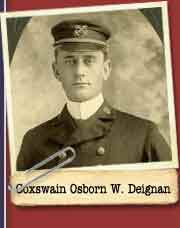
Coxswain Osborn W. Deignan
Coxswain John E. Murphy
Chief Master-At-Arms Daniel Montague
Gunner's Mate First Class George Charette
Machinist First Class George F. Phillips
Watertender Francis Kelly

Machinist Mate 1st Class George F. Phillips, USN, (1862-1904)


Chief Machinist (?) George F. Phillips, USN, (1862-1904)
George Frederick Phillips was born on 8 March 1862 in St. John, New Brunswick, Canada. He enlisted in the US Navy from Galveston, Texas and served as a Machinist First Class in the collier Merrimac during the Spanish-American War. Phillips remained with her as one of eight volunteer crew members when Rear Admiral William T. Sampson ordered Merrimac sunk to block the entrance of Santiago Harbor, Cuba. On the night of 2-3 June 1898, during the courageous attempt to execute this mission, Merrimac's steering gear was disabled by enemy gunfire, and she sank without obstructing navigation. Her crewmen were rescued by the Spanish and made prisoners-of-war. After the Battle of Santiago de Cuba destroyed the Spanish fleet a month later, Phillips and his shipmates were released. For his "extraordinary heroism" during this operation, he was awarded the Medal of Honor.
George F. Phillips may have remained in the Navy after the Spanish-American War, since one published source on the Medal of Honor states that his highest rank was Chief Machinist (a warrant officer rank). However, no mention of him could be located in any Navy Register or Navy Reserve Register from 1899 to 1957. The same source reports that he died on 4 June 1904 in Cambridge, Massachusetts and is buried at Fernhill Cemetery, St. John, New Brunswick.

Medal o Honor Citation

Rank and organization: Machinist First Class, U.S. Navy. Born: 9 March 1864, Boston, Mass. Accredited to: New York. G.O. No.: 529, 2 November 1899. Citation: In connection with the sinking of the U.S.S. Merrimac at the entrance to the harbor of Santiago de Cuba 2 June 1898. Despite heavy fire from the Spanish shore batteries, Phillips displayed extraordinary heroism throughout this operation.
Coxswain John Edward Murphy (1869 – 1941)


John Edward Murphy (May 3, 1869 – April 9, 1941) was a United States Navy sailor and a recipient of America's highest military decoration—the Medal of Honor—for his actions in the Spanish-American War.
Murphy enlisted in the U.S. Navy from New York and served in the battleship USS Iowa (BB-4) as a coxswain during the Spanish-American War. Coxswain Murphy was one of eight volunteer crew members of the collier USS Merrimac (1898), which Rear Admiral William T. Sampson ordered sunk to block the entrance of Santiago Harbor, Cuba. On the night of June 2/3, 1898, during the attempt to execute this mission, Merrimac's steering gear was disabled by enemy gunfire, and she sank without obstructing navigation. Her crewmen were rescued by the Spanish and made prisoners-of-war. After the Battle of Santiago de Cuba destroyed the Spanish fleet a month later, Murphy and his shipmates were released. For their part in this operation, all eight men were awarded Medals of Honor.
On June 15, 1898, while he was still in Spanish custody, Murphy was promoted to the warrant officer rank of Boatswain. In October 1898, Murphy was assigned to the battleship USS Oregon (BB-3), which soon went to the Asiatic Station. He reported for training duty on board USS Pensacola (1859) in September 1901 and several months later began similar service in USS Constellation (1854). In the Summer of 1903 he was assigned to the armored cruiser USS New York (ACR-2) in the Pacific Squadron. Murphy was promoted to Chief Boatswain on June 15, 1904. For his last tour, he served in USS Buffalo (1892), also in the Pacific, and was placed on the retired list on August 1, 1905.
Chief Boatswain John Edward Murphy died at age 71 and was buried at Fort Rosecrans National Cemetery, San Diego, California. His grave can be found in the officer's section, grave 363 GPS (lat/lon): 32.41418, -117.14673.
Medal of Honor citation
Coxswain Murphy's official Medal of Honor citation reads: In connection with the sinking of the U.S.S. Merrimac at the entrance to the harbor of Santiago de Cuba, 2 June 1898. Despite heavy fire from the Spanish shore batteries, Murphy displayed extraordinary heroism throughout this operation.

Chief Master-At-Arms Daniel Montague (1867 – 1912)


Daniel Montague (October 22, 1866 or 1867 – February 4, 1912) was a United States Navy sailor and a recipient of America's highest military decoration—the Medal of Honor—for his actions in the Spanish-American War.
Daniel Montague enlisted in the Navy during the mid-1890s and served in USS New York (ACR-2) during the Spanish-American War as a Chief Master-at-Arms. He was one of eight volunteer crew members of the collier USS Merrimac, which Rear Admiral William T. Sampson ordered sunk to block the entrance of Santiago Harbor, Cuba. On the night of 2-June 3, 1898, during the attempt to execute this mission, Merrimac's steering gear was disabled by enemy gunfire, and she sank without obstructing navigation. Her crewmen were rescued by the Spanish and made prisoners-of-war. After the Battle of Santiago de Cuba destroyed the Spanish fleet a month later, Montague and his shipmates were released. For their actions during this operation, all eight men were awarded the Medal of Honor.
Montague was promoted to the warrant officer rank of Boatswain on June 15, 1898, while he was still in Spanish custody. His initial post-war assignment, to the training ship Lancaster, lasted from August 1898 to late in 1901. He then reported for duty at the U.S. Naval Academy, Annapolis, Maryland. In June 1903 Boatswain Montague reported on board the battleship USS Wisconsin, serving as Asiatic Station flagship. Montague was promoted to Chief Boatswain in June 1904 and late in that year began service in the old steam sloop USS Mohican station ship at Olongapo, Philippines. In the summer of 1906 he was assigned duty at Naval Station, Pensacola, Florida, remaining there until the fall of 1909 when he was transferred to the Philadelphia Naval Yard, Pennsylvania. His last active assignment, in 1911-1912, was to the cruiser USS Olympia at Norfolk, Virginia, where she was being prepared for use as a barracks ship.
Daniel Montague died at age 44 or 45 and was buried at the U.S. Naval Academy Cemetery, Annapolis, Maryland.
Medal of Honor citation
Rank and organization: Chief Master-at-Arms, U.S. Navy. Born: October 22, 1867, Wicklow, Ireland. G.O. No.: 529, November 2, 1899.
Citation: In connection with the sinking of the U.S.S. Merrimac at the entrance to the harbor of Santiago de Cuba, June 2, 1898. Despite heavy fire from the Spanish batteries, Montague displayed extraordinary heroism throughout this operation.

Machinist's Mate 2 Class Francis Kelly (1860 – 1938)


Francis Kelly (July 5, 1860 – May 19, 1938) was a United States Navy sailor and a recipient of America's highest military decoration — the Medal of Honor — for his actions in the Spanish-American War.
Francis Kelly enlisted in the US Navy from his birth state, Massachusetts, and served as a watertender in the collier USS Merrimac during the Spanish-American War. Kelly was one of eight volunteer crew members when Rear Admiral William T. Sampson ordered Merrimac sunk to block the entrance of Santiago Harbor, Cuba. On the night of 2-June 3, 1898, during the attempt to execute this mission, Merrimac's steering gear was disabled by enemy gunfire, and she sank without obstructing navigation. Her crewmen were rescued by the Spanish and made prisoners-of-war. After the Battle of Santiago de Cuba destroyed the Spanish fleet a month later, Kelly and his shipmates were released. For his actions during this operation, he was awarded the Medal of Honor.
Francis Kelly remained in the Navy after the Spanish-American War, ultimately obtaining the rank of chief machinist's mate. He is buried at Sandymount Cemetery, Glasgow, Scotland.
Medal of Honor citation
Kelly's official Medal of Honor citation reads: In connection with the sinking of the U.S.S. Merrimac at the entrance to the harbor of Santiago de Cuba, June 2, 1898. Despite heavy fire from the Spanish batteries, KELLY displayed extraordinary heroism throughout this operation.

Lieutenant Richmond Pearson Hobson (1870 – 1937)


Richmond Pearson Hobson (August 17, 1870 – March 16, 1937) was a United States Navy Rear Admiral who served from 1907-1915 as a U.S. Representative from Alabama. A veteran of the Spanish-American War, he received the Medal of Honor years later for his part in that conflict.
He was born at Magnolia Grove in Greensboro in Hale County in the western Black Belt of Alabama. He graduated from the Naval Academy in 1889. He was ostracized by his fellow midshipmen for his total abstinence from alcohol and tobacco. He maintained a superb academic record graduating first in his class and became the highest ranking midshipman: Cadet Battalion Commander (today's Brigade Commander). After duty in Chicago, he underwent additional training and was appointed Assistant Naval Constructor in 1891. Hobson then served at various Navy Yards and facilities, including a tour of duty as instructor at the Naval Academy.
In the early days of Spanish-American War, he was with Admiral William T. Sampson in New York, and arrived off Santiago June 1, 1898. In order to bottle up the Spanish squadron of Admiral Pascual Cervera y Topete, Hobson took temporary command of collier Merrimac, which he would attempt to sink as an obstruction in the channel. The attempt was made early June 3, under heavy Spanish fire, which disabled the steering gear of the collier. Hobson did sink the Merrimac, but was unable to place her in the shallowest part of the channel. With his intrepid crew of six, he was picked up by Admiral Cervera himself, and treated quite chivalrously for his gallant expedition.
Hobson became a hero of the American press while he was a prisoner of war in Cuba. His portrait appeared in hundreds of newspapers with embellished stories of his bravery in volunteering for what was perceived as a suicide mission. A fund was raised to aid his parents in avoiding foreclosure of their mortgage. When Hobson was released during a prisoner exchange on 6 July 1898, hundreds of American troops snapped to attention, then burst into cheers as he passed. He was deluged with speaking invitations when he returned to the United States. After dining with President William McKinley, Hobson traveled west by train en route to San Francisco and the Philippines. Crowds greeted his train at many stations, and his enthusiasm for kissing admiring young women made him a sex symbol of the Victorian age.
Hobson was advanced ten numbers in grade after the war and later, in 1933, awarded the Medal of Honor for his heroic attempt to block the channel. After the Spanish-American War he worked on the repairing and refitting of captured Spanish cruisers at Cavite and at various shore stations of the Navy.
One of his close friends was American genius and inventor Nikola Tesla. In later years, Hobson was the only person who was able to persuade Tesla to interrupt his intellectual pursuits for a movie gathering.
Hobson was the author of a book about the events surrounding the sinking of collier Merrimac in which he participated as the leader of a volunteer squad.
After resigning from active duty in 1903, Hobson remained a staunch supporter of the Navy and during his subsequent career as a Democratic U.S. Representative from Alabama, 1905–1915, was a firm advocate of naval expansion. He was denied renomination in the 1914 Democratic primary. In 1934, by special act of the United States Congress, he was advanced to Naval Constructor with a rank of Rear Admiral, and placed on the retired list. Rear Admiral Hobson died March 16, 1937 in New York City. He is interred in Arlington National Cemetery in Virginia.
The destroyer USS Hobson (DD-464) was named in his honor. A small town in south Texas was renamed from Castine to Hobson after Capt. Richmond Pearson Hobson spoke there on a railroad tour.
Medal of Honor citation
Rank and organization: Lieutenant, U.S. Navy. Born: 17 August 1870, Greensboro, Ala. Accredited to: New York. (Medal presented by President, 29 April 1933.)
Citation: In connection with the sinking of the U.S.S. Merrimac at the entrance to the fortified harbor of Santiago de Cuba, 3 June 1898. Despite persistent fire from the enemy fleet and fortifications on shore, Lt. Hobson distinguished himself by extraordinary courage and carried out this operation at the risk of his own personal safety.

Coxswain Claus Kristian Randolph Clausen (1869 – 1958)


Claus Kristian Randolph Clausen (December 9, 1869 – December 23, 1958) was an enlisted man and later an officer in the United States Navy. He received America's highest military decoration - the Medal of Honor - for actions in the Spanish-American War.
Claus Kristian Randolph Clausen was born on December 9, 1869 in Denmark. Later enlisting in the Navy from the state of New York, he served on the USS New York during the Spanish American War as a Coxswain. He was one of eight volunteer crew members of the collier USS Merrimac, which Rear Admiral William T. Sampson ordered sunk to block the entrance of Santiago Harbor, Cuba. On the night of 2-June 3, 1898, during the attempt to execute this mission, Merrimac's steering gear was disabled by enemy gunfire, and she sank without obstructing navigation. Her crewmen were rescued by the Spanish and made prisoners-of-war. After the Battle of Santiago de Cuba destroyed the Spanish fleet a month later, Clausen and his shipmates were released. For his "extraordinary heroism" during this operation, he was awarded the Medal of Honor.
Clausen was promoted to the Warrant Officer rank of Boatswain on July 30, 1903. As an officer, his initial assignment was on the cruiser USS Detroit, operating in the Caribbean. Following this sea duty, he served two years on the New York Navy Yard's receiving ship USS Hancock. Boatswain Clausen's next time at sea was on the battleship USS Mississippi from 1908 to 1911. On July 30, 1909, while on Mississippi, he was promoted to Chief Boatswain. After another tour at the New York Navy Yard, from 1911 to 1914, Chief Boatswain Clausen obtained the special qualification of a "Master's License under Steamboat-Inspection Service" before reporting on board battleship USS New Jersey. He served in her during World War I and received a temporary promotion to Lieutenant, Junior Grade in May 1917.
After the war, Clausen transferred back to the New York Navy Yard and, in 1920, reverted to Chief Boatswain. His next shipboard assignment was as an officer of USS Florida. In November 1922, he transferred to the Naval Torpedo Station, Newport, Rhode Island and three months later reported on board the receiving ship USS Colorado (ACR-7) at New York. Chief Boatswain Clausen was placed on the retired list on November 15, 1925. Though retired, he was promoted to Lieutenant in June 1930, but again reverted to Chief Warrant Officer 4 in the early 1950s. He lived his later years in Massapequa Park, New York, and at his death was the last surviving Medal of Honor recipient from the Spanish American War. Claus K. R. Clausen died on December 23, 1958 at St. Albans, New York and is interred in the U.S. Columbarium, Middle Village, New York.
Medal of Honor citation
Rank and organization: Coxswain, U.S. Navy. Born: December 9, 1869, Denmark. Accredited to: New York. G.O. No.: 529, November 2, 1899.
Citation: In connection with the sinking of the U.S.S. Merrimac at the entrance to the harbor of Santiago de Cuba, 2 June 1898. Despite heavy fire from the Spanish batteries, Clausen displayed extraordinary heroism throughout this operation.

GM1 George Charrette (1867 - 1938)


George Charrette (June 6, 1867 – February 7, 1938) was an enlisted man and later officer in the United States Navy who received the Medal of Honor for his heroism during the Spanish-American War.
Charrette was born in Lowell, Massachusetts on June 6, 1867. He enlisted in the United States Navy September 24, 1884. As a Gunner's Mate third class, on June 2, 1898, he volunteered with seven others to sink USS Merrimac under heavy Spanish fire across the entrance to the harbor of Santiago, Cuba, thus bottling up the enemy fleet. Taken prisoner by the Spanish, Charrette was exchanged July 6, 1898. He was awarded the Medal of Honor for extraordinary heroism, although his name was misspelled as George Charette on the citation. Charrette was commissioned lieutenant on August 3, 1920, and retired from the Navy in 1925. He died February 7, 1938 in Lowell, Massachusetts and was buried in Arlington National Cemetery, Arlington County, Virginia.

Medal of Honor Ctation

Rank and organization: Gunner's Mate First Class, U.S. Navy. Entered service at: Lowell, Mass. Born: 6 June 1867, Lowell, Mass. G.O. No.: 529, 2 November 1899. Citation: In connection with the sinking of the U.S.S. Merrimac at the entrance to the harbor of Santiago de Cuba, 2 June 1898. Despite heavy fire from the Spanish batteries, Charette displayed extraordinary heroism throughout this operation.

Wednesday, November 3, 2010

Seaman Osborn Warren Deignan (1873 – 1916)


Osborn Warren Deignan (February 24, 1873 – April 16, 1916) was an enlisted sailor and later a Warrant Officer in the United States Navy. He received his country's highest military decoration—the Medal of Honor—for actions in the Spanish-American War. Born in Iowa, he joined the Navy in 1894 and participated in the Battle of Santiago de Cuba, the largest naval engagement of the Spanish-American war. Deignan and seven others attempted to block the entrance to Santiago Harbor, Cuba but the Spanish destroyed their ship before they could accomplish their mission, and took them prisoner. The men were later released and Deignan received the Medal of Honor for his actions. He went on to become an officer and served in various posts and ships throughout the Navy until retiring in 1906. He died in Colorado in 1916, and was buried in California.
Deignan was born February 24, 1873 (as per first Navy enlistment record dated December 7, 1894) near Stuart, Iowa to John Deignan and his wife. His father had also been a sailor, serving in the Navy during the American Civil War, and afterwards went to work for the Rock Island Railway as a conductor. When Osborn was five years old, a torndado struck his father's train in Grinnel, Iowa, killing him and leaving Osborn, his mother and his brother to survive on their own. His mother remarried and the family, along with two additional children from his new stepfather, moved to North Tremont Street in Stuart. In 1887 he left school and went to sea, serving on ships in the Atlantic ocean, the Arctic and the Caribbean.
Deignan enlisted in the United States Navy from his home state of Iowa, originally on December 7, 1894 (as per first Navy enlistment record). He served on numerous USN vessels between 1894 and 1896 and, having deserted from the USS Newark on May 6, 1896 (as per naval records maintained by the Military Record Center) then re-enlistment in 1898 (as per naval records maintained by the Military Record Center.) He was assigned as a Coxswain to the USS Merrimac (1898) during the Spanish-American War. The Merrimac had frequent problems with the steering and engines, and Deignan referred to it as "cranky". After a short time on the ship, he garnered a reputation as an able helmsman and was preferred when delivering coal to the other ships in the fleet, a task that could be difficult in a ship that was already hard to control.
When Rear Admiral William T. Sampson requested volunteers for an extremely dangerous mission, there were more than enough volunteers, but he chose Osborn as the helmsman. The mission was to sink Merrimac at the entrance to Santiago Harbor, Cuba in an effort to block it and pen the Spanish Navy in the harbor. Seven other members of the crew were also chosen for the assignment. While the crew was attempting to fulfill its mission, Spanish forces fired on the ship and, in the process, disabled the Merrimac's streering controls before the crew could complete their task. The ship sank without obstructing navigation, but the crew was able to escape the ship before she went under. They were rescued by the Spanish and were taken as prisoners-of-war. A month later the Spanish fleet was destroyed at the Battle of Santiago de Cuba and the crewman were released. For his "extraordinary heroism" during the operation, Deignan was awarded the Medal of Honor.
On April 9, 1900, Deignan was promoted to the Warrant Officer rank of Boatswain. As an officer, his initial assignments were in the Philippines, first at Manila, then at the Naval Station, Cavite. After meeting her at a party in 1898, he married Maud Huntoon on May 14, 1902 and together they had a daughter. In June 1902, he reported for duty on the USS Oregon (BB-3) and later that year transferred to the receiving ship USS Independence (1814), at the Mare Island Naval Shipyard, California. He was stationed at Navy Yard, Pensacola, Florida, from 1903 through 1904, and then was assigned to the receiving ship USS Franklin (1864), at Norfolk, Virginia. He remained there for less than a year before reporting for his last tour of duty on the monitor USS Amphitrite (BM-2) in April 1905. He retired on April 21, 1906 and moved to the Los Angeles, California area.
Deignan died April 16, 1916 in Cannon City, Colorado at the age of 43 (based on birth in 1873) and was buried with full military honors at Forest Lawn Memorial Park, Glendale, California. His grave can be found in the Whispering Pines section, L-1165. Post #1842 of the Veterans of Foreign Wars was named in his honor.
Medal of Honor Citation
Rank and organization: Coxswain, U.S. Navy. Born: 24 February 1873, Sheart, Iowa. Accredited to: Iowa. G.O. No.: 529, 2 November 1899. Citation: In connection with the sinking of the U.S.S. Merrimac at the entrance to the harbor of Santiago de Cuba, 2 June 1898. Despite heavy fire from the Spanish batteries, Deignan displayed extraordinary heroism throughout this operation.