Medal of Honor

Medal of Honor
Showing posts with label Officer. Show all posts

Thursday, November 25, 2010

Charles Edward Phelps (May 1, 1833 – December 27, 1908)


Charles Edward Phelps (May 1, 1833 – December 27, 1908) rose to the rank of Brigadier General in the U.S. Army in the Civil War, served as a city councilman, a U.S. Congressman from the third district of Maryland, and received the Medal of Honor.

Phelps was born in Guilford, Vermont, on May 1, 1833. His father was John Phelps, a lawyer and Senator in the Vermont State government. At the age of 5, he moved with his parents to Pennsylvania, and at the age of 8 to Maryland, when his mother, Almira Hart Lincoln Phelps,(sister of Emma Willard), became principal of the Patapsco Female Seminary in Ellicott City. He matriculated at Princeton University, where he was admitted to the Zeta Psi fraternity, graduating in 1852. He then studied at Harvard University Law School, graduating in 1853. He joined the Maryland bar in 1855. He was admitted to practice in the Supreme Court of the United States in 1859. In 1860, he was elected to the Baltimore city council.

In 1861, he was commissioned a major of the Maryland Guard, and, in 1862, he was raised to lieutenant colonel of the Seventh Maryland Volunteers, fighting for the Union. He became colonel in 1863. His horse was killed under him at the battle of the Wilderness in 1864. While leading a charge on the “crater” at Spotsylvania (VA), he was wounded and taken prisoner. However, he was later rescued by General Sheridan’s Calvary. He was honorably discharged on account of wounds in 1864, and was shortly thereafter elected as congressman from the 3rd district of Maryland to the Thirty-Ninth Congress, and was reelected to the Fortieth Congress. He was subsequently given commission as brevet Brigadier General, and received the Medal of Honor for valor at the Battle of Spotsylvania.

In 1868, he married Martha Woodward of Baltimore. He was professor of equity at Maryland University Law School, and served for many years as Judge of the Supreme Bench of Baltimore. In 1901, he published the book "Falstaff and Equity," relating legal arguments to Shakespeare. In 1907 he received an honorary Doctor of Laws from Princeton University. died in 1908 at age 75

Medal of Honor citation

Rank and Organization: Colonel, 7th Maryland Infantry. Place and date: At Laurel Hill, Va., May 8, 1864. Entered service at: Baltimore, Md. Born: May 1, 1833, Guilford, Vt. Date of issue: March 30, 1898.

Citation: The President of the United States of America, in the name of Congress, takes pleasure in presenting the Medal of Honor to Colonel Charles Edwards Phelps, United States Army, for extraordinary heroism on 8 May 1864, while serving with 7th Maryland Infantry, in action at Laurel Hill, Virginia. Colonel Phelps rode to the head of the assaulting column, then much broken by severe losses and faltering under the close fire of artillery, placed himself conspicuously in front of the troops, and gallantly rallied and led them to within a few feet of the enemy's works, where he was severely wounded and captured.

Tuesday, November 23, 2010

Brevet Brigadier General William Herbert Withington (1835 – 1903)


Civil War Union Brevet Brigadier General, Congressional Medal of Honor Recipient. When the Civil War began, he enlisted in the 1st Michigan Infantry and was commissioned Captain. Colonel William H. Withington, commanding 17th Michigan Infantry: One of the many Union soldiers captured following the debacle following the First Battle of Bull Run, William Withington, then a captain in the 1st Michigan, was held in a Rebel prison camp until January 1862 when he was finally exchanged. Withington was sent back to Michigan to recruit more men for the war and upon raising the 17th Michigan, he was appointed its Colonel. The 17th Michigan would train at Fort Wayne until late August 1862 when it was sent east to reinforce George B. McClellan's Army of the Potomac and assist in pushing the Confederate army out of Maryland. The regiment would be assigned to the brigade of Colonel Benjamin Christ in the 1st Division, 9th Army Corps. The first battle this regiment would participate in would be at South Mountain. In the afternoon of the 14th, the 17th was deployed on the right of the Old Sharpsburg Road facing west across Wise's North Field. In front of them were the men of 50th and 51st Georgia of Drayton's Brigade and the Jeff Davis Artillery of Captain James Bondurant. Just before the Union attack was to commence, the Confederates themselves attack. The Georgians were pulled out of their position and moved into the road uncovering Bondurant's battery. With orders to advance, Withington pushed his men forward against Bondurant's battery and into the left flank of Drayton's Georgians in the Old Sharpsburg Road. The attack surprised Drayton's men and with the advance of Union units on their left, the 17th Michigan got behind the Georgians trapping them in a 3-sided kill zone. The Georgians returned fire the best they could but it was suicide to attempt to stand. The Michigan men had precipitated a Confederate rout. The regiment killed and wounded dozens of Confederate troops while capturing many more. The loss for the regiment in this fight was 27 killed and 114 wounded out of 500 who were taken into the fight. The regiment earned the "Stonewall Regiment" nickname following its capture and rout of those Confederates behind the stonewall in Wise's North Field despite the regiment receiving less than a months worth of training. Colonel Withington was breveted a Brigadier General for his leadership at South Mountain. He would be either mustered out or he resigned in early 1863. Following the war, he would serve several terms in the Michigan Legislature as both a representative and senator. He would receive the Medal of Honor in the 1890's for his actions in tending and remaining with his superior officer, Colonel Orlando Willcox, after Willcox was wounded and the two came under heavy fire at the Battle of First Bull Run. He would pass away in 1903 at the age of 68.
his obituary WILLIAM HERBERT WITHINGTON, soldier, manufacturer and capitalist, was born at Dorchester, Mass., February 1, 1835, son of William and Elizabeth W. (Ford) Withington. His earliest paternal American ancestor was Henry Withington, who came from England, in 1635, with the company of Rev. Richard Mather (q.v.), the first minister at Dorchester, in whose church Henry Withington was ruling elder. Rev. William Withington, father of the subject, was an eloquent and powerful preacher, and a mathematician and linguist of more than ordinary attainments. The son received his education in the public schools of Boston and at Phillips (Andover) Academy. He then became a salesman in a Boston leather store and later bookkeeper for the North Wayne Scythe Company. In 1857 he entered the employ of Pinney & Lamson, manufacturers of agricultural implements, at Jackson, Mich. He had charge not only of the office, but the shops of an extensive plant employing many workmen and a large corps of traveling salesmen. In 1858 they sold out to the newly organized firm of Sprague, Withington & Company, afterwards the Withington & Cooley Manufacturing Company, manufacturers of farm and garden tools, whose trade extends to Australia, South America and throughout Q Europe. He was also president of the Q Union Bank, Grand River Valley Railroad Q Company, and the Jackson Vehicle Company, Jackson; Withington Handle Company, Fort Wayne and Huntington, Ind.; Withington & Russell Company, Nashville, Tenn.; Geneva (Ohio) Tool Company; Oneida Farm Tool Company, Utica, N. Y.; Webster Wagon Company, Moundsville, W. Va.; National Snath Company, Erie, Pa., and the Steel Goods Association, New York City. Since 1875 he was also a director in the Iowa Farming Tool Company, Fort Madison, Iowa. In 1902, when nearly all the manufacturers of agricultural implements merged, he was chosen president, and thereafter a large part of his time was spent in Cleveland, Ohio. His interest in military affairs was enthusiastic, and he aided in organizing the Jackson Grays, of which he was captain at the outbreak of the civil war. The Grays answered Lincoln's first call for troops, and became Company B, 1st Michigan Volunteer Infantry. He was assigned to the Army of the Potomac and participated in the capture of Alexandria, Va.; was taken prisoner at the first battle of Bull Run, being confined at Richmond, Charleston and Columbia, but was later exchanged and returned to Jackson. He was awarded one of the congressional medals of honor for special service at Bull Run—for "most distinguished gallantry in voluntarily remaining on the field, under heavy fire, to aid and succor your superior officer." Later he was appointed colonel of the 17th Michigan regiment, and was immediately sent into the Maryland campaign under McClellan. At South Mountain he made a splendid charge upon the stone walls behind which the enemy with its batteries was posted, drove confederates down the slope of the mountain, and captured 300 prisoners, but, lost more than a hundred of his own men. Similar valor was displayed at Antietam by his "Stonewall regiment" as it came to be called, and he continued in command until March, 1863, when he resigned his commission. Immediately following was made brevet brigadier-general for "Conspicuous gallantry" at the battle of South Mountain, being one of the youngest men in the Federal army on whom so high an honor was conferred. He became a dominant factor in civic and municipal affairs, as well as in Republican politics. After serving as alderman, he was elected to the Michigan house of representatives in 1873, and was a member also of the special session of 1874. He was the originator of a bill providing for the creation of an effective state militia: became colonel of the first regiment formed in accordance therewith, and when the state troops were organized into a brigade, 1879, he was appointed brigadier-general, resigning in 1883. He was state senator during 1891-1892, and was delegate to the National Republican conventions of 1876 and 1892. For four years he was a member of the Republican state central committee. He was a member of the board of trustees of the Michigan Asylum for the Insane, Kalamazoo, and of the board of managers of the Soldier's Home, Grand Rapids; was president of the Jackson board of trade; an organizer and president of the Young Men's Library Association, and president of the Jackson Public Library. He was past department commander of the Military Order of the Loyal Legion, and a member also of the Grand Army of the Republic, Masonic Fraternity, and the Michigan and Detroit clubs, Jackson. For 42 years he was Vestryman and for 22 years warden of St Paul's Protestant Episcopal parish, and was twice delegate to the triennial general convention of his church. He was sturdy of character, and his success was built on a foundation of intelligence, zeal, integrity, loyalty and comradeship. He was married, June 6 1859 to Julia C., daughter of Joseph E Beebe, a manufacturer of Jackson Michigan.; she survives him with three children Phillip H of Cleveland; Winthrop Jackson, and Kate Winifred, wife of Dr. Flemming Carrow, Traverse City Michigan., June 27, 1906
Medal of Honor Citation
Rank and organization: Captain, Company B, 1st Michigan Infantry. Place and date: At Bull Run, Va., 21 July 1861._ Entered service at: Jackson, Mich. Born: 1 February 1835, Dorchester, Mass. Date of issue: 7 January 1895. Citation: The President of the United States of America, in the name of Congress, takes pleasure in presenting the Medal of Honor to Captain (Infantry) William Herbert Withington, United States Army, for extraordinary heroism on 21 July 1861, while serving with Company B, 1st Michigan Infantry, in action at Bull Run, Virginia. Captain Withington remained on the field under heavy fire to succor his superior officer.

Monday, November 8, 2010

Abraham Jay Buckles (1846 - 1915)


Birth: Aug. 2, 1846, USA Death: Jan. 9, 1915, US Army Civil War Congressional Medal of Honor Recipient. When war broke out in 1861, he joined Company E, 19th Indiana Volunteer Infantry, which became a part the “Iron Brigade” First Division, First Army Corps, Army of the Potomac. He was wounded numerous times in several notorious Civil War battles - at the second Bull Run battle he was shot through the right thigh and taken prisoner, but escaped soon after. Prior to the Gettysburg campaign he had been detailed, at his own request, as one of the color guard, and during the Gettysburg battle he rescued the flag of his regiment, but was soon after struck in the right shoulder. He was so disabled that he could never after carry a knapsack. When he was sufficiently recovered, although the wound was not healed, he returned to his regiment, and was at once made the color-bearer. At the battle of the Wilderness, while carrying the flag he was shot through the body, and when carried to the rear was informed by the surgeon that he must die, as his wound was a fatal one. So certain were all that he would not recover the report went forth “Killed in the Wilderness.” For this action he was awarded the Medal of Honor on December 4, 1893. His citation, issued to Abram J. Buckle reads: “Though suffering from an open wound, carried the regimental colors until again wounded.” However, being of a strong constitution and possessed of an iron will he recovered sufficiently to return to the front where he found his regiment so depleted in numbers that it had been consolidated with the Twentieth Indiana, and in this regiment he was given a commission as Second Lieutenant, dated February 27, 1865. Buckles’ right leg was amputated after being shot through the knee at the Hatchin Run on March 25, 1865. In 1886 he recovered a small Bible, carried by him in that battle and lost there, which on the fly-leaf bore the words “Killed in the Wilderness.” After his discharge as a 2nd Lieutenant, he became a teacher. He was admitted to the Indiana Bar in 1875 and moved to Dixon, California. In 1879, he was elected District Attorney of Solano County and retained that position until 1884, when he became Judge of the Superior Court of Solano County. Governor Pardee named Buckles to the newly created Court of Appeal, Third Appellate District, in April 1905 and served until 1907. He returned to practice in Fairfield, and in 1908 returned to the bench of the Superior Court of Solano County, where he served for the remainder of his life. He died 11 days after an operation in Ramona Hospital in San Bernardino County in 1915.

Medal of Honor Citation
Rank and organization: Sergeant, Company E, 19th Indiana Infantry. Place and date: At Wilderness, Va., 5 May 1864. Entered service at: Muncie, Ind. Birth: Delaware County, Ind. Date of issue: 4 December 1893. Citation: Though suffering from an open wound, carried the regimental colors until again wounded.

Zenas Randall Bliss (1835 – 1900)


Zenas Randall Bliss (April 17, 1835 – January 2, 1900) was an officer and general in the United States Army and a recipient of the Medal of Honor. He formed the first unit of Seminole-Negro Indian Scouts, and his detailed memoirs chronicled life on the Texas frontier.
Bliss was a native of Rhode Island and graduated from West Point in 1854. He served most of his thirty-seven year career on the Texas frontier, and served in the Union Army during the American Civil War. During the Civil War he was captured by Confederate forces and held as a prisoner of war. Bliss received the Medal of Honor for his actions while leading his regiment at the Battle of Fredericksburg.
Bliss was born April 17, 1835 in Johnston, Rhode Island to an upper-middle class family. His parents were Zenas and Phebe Waterman Randall Bliss. He received an appointment to the United States Military Academy at West Point, New York, in July 1850 when he was only fifteen years old. He graduated from West Point in 1854 and served the next six years in Texas. He was stationed at Fort Davis and Fort Quitman, but his first assignment was as a brevet second lieutenant in the 1st U.S. Infantry regiment. He was promoted to the full rank of second lieutenant in the 8th U.S. Infantry on March 3, 1855 and subsequently promoted to first lieutenant on October 17, 1860. He was promoted to captain on May 14, 1861.
When the American Civil War began on April 12, 1861 Bliss immediately saw action. He was captured by Confederate forces and spent eleven months as a prisoner of war, first in San Antonio, Texas, and later in Richmond, Virginia. He was finally exchanged and sent back to Union lines where he subsequently took command of the Tenth Rhode Island Infantry. He received a commission in the volunteer army as a colonel in May 1862. Bliss assumed command of the Seventh Rhode Island Infantry on August 21, 1862. In October 1862 the Seventh Rhode Island joined the First Brigade, Second Division, Ninth Corps, Army of the Potomac. The regiment saw action in December 1862 at the Battle of Fredericksburg, during which Bliss performed actions that earned him the Medal of Honor several decades later. When IX Corps was sent West, it participated in the Siege of Vicksburg. The Seventh served under Major General William T. Sherman in the capture of Jackson, Mississippi. In April 1864 the Seventh rejoined the Army of the Potomac. Bliss became commander of the First Brigade, Second Division, Ninth Corps. His brigade fought in the Battle of the Wilderness. Bliss was badly injured by a horse at Spotsylvania, but he returned to lead his brigade in the Siege of Petersburg and the Battle of the Crater. The court of inquiry following the fiasco at the Crater censured Bliss, but he remained on duty. During the Civil War, Bliss received a brevet (honorary promotion) to major dated December 13, 1862, for "gallantry and meritorious service" in the Battle of Fredericksburg. He was later breveted to lieutenant colonel on May 7, 1864, for "gallantry and meritorious service" in the Battle of the Wilderness. He was awarded the Medal of Honor on December 3, 1898, for valor during the Battle of Fredericksburg.
Bliss remained in the Regular Army after the Civil War and was promoted to major of the 39th Infantry Regiment (a unit with black soldiers and white officers) on August 6, 1867. He was promoted to lieutenant colonel of the 19th Infantry on March 4, 1879, and to colonel of the 24th Infantry on April 20, 1886. Bliss was promoted to brigadier general in the Regular Army April 24, 1895, and to major general on May 14, 1897. He retired from the Army eight days later on May 22. Including his four years at West Point, Bliss had served 46 years, 10 months and 22 days in uniform when he retired.
Zenas Bliss died in Washington, D.C. January 2, 1900, at age 64. He is buried alongside his wife at Arlington National Cemetery at Arlington, Virginia. His grave can be found in section 1, lot 8-B. The Bliss family had four children, two of whom lived to adulthood.

Medal of Honor Citation
Rank and organization: Colonel, 7th Rhode Island Infantry. Place and date: At Fredericksburg, Va., 13 December 1862. Entered service at: Johnston, Maine. Birth: Johnston, Maine. Date of issue: 30 December 1898. Citation: This officer, to encourage his regimen; which had never before been in action, and which had been ordered to lie down to protect itself from the enemy's fire, arose to his feet, advanced in front of the line, and himself fired several shots at the enemy at short range, being fully exposed to their fire at the time.

Friday, November 5, 2010

Lieutenant Richmond Pearson Hobson (1870 – 1937)


Richmond Pearson Hobson (August 17, 1870 – March 16, 1937) was a United States Navy Rear Admiral who served from 1907-1915 as a U.S. Representative from Alabama. A veteran of the Spanish-American War, he received the Medal of Honor years later for his part in that conflict.
He was born at Magnolia Grove in Greensboro in Hale County in the western Black Belt of Alabama. He graduated from the Naval Academy in 1889. He was ostracized by his fellow midshipmen for his total abstinence from alcohol and tobacco. He maintained a superb academic record graduating first in his class and became the highest ranking midshipman: Cadet Battalion Commander (today's Brigade Commander). After duty in Chicago, he underwent additional training and was appointed Assistant Naval Constructor in 1891. Hobson then served at various Navy Yards and facilities, including a tour of duty as instructor at the Naval Academy.
In the early days of Spanish-American War, he was with Admiral William T. Sampson in New York, and arrived off Santiago June 1, 1898. In order to bottle up the Spanish squadron of Admiral Pascual Cervera y Topete, Hobson took temporary command of collier Merrimac, which he would attempt to sink as an obstruction in the channel. The attempt was made early June 3, under heavy Spanish fire, which disabled the steering gear of the collier. Hobson did sink the Merrimac, but was unable to place her in the shallowest part of the channel. With his intrepid crew of six, he was picked up by Admiral Cervera himself, and treated quite chivalrously for his gallant expedition.
Hobson became a hero of the American press while he was a prisoner of war in Cuba. His portrait appeared in hundreds of newspapers with embellished stories of his bravery in volunteering for what was perceived as a suicide mission. A fund was raised to aid his parents in avoiding foreclosure of their mortgage. When Hobson was released during a prisoner exchange on 6 July 1898, hundreds of American troops snapped to attention, then burst into cheers as he passed. He was deluged with speaking invitations when he returned to the United States. After dining with President William McKinley, Hobson traveled west by train en route to San Francisco and the Philippines. Crowds greeted his train at many stations, and his enthusiasm for kissing admiring young women made him a sex symbol of the Victorian age.
Hobson was advanced ten numbers in grade after the war and later, in 1933, awarded the Medal of Honor for his heroic attempt to block the channel. After the Spanish-American War he worked on the repairing and refitting of captured Spanish cruisers at Cavite and at various shore stations of the Navy.
One of his close friends was American genius and inventor Nikola Tesla. In later years, Hobson was the only person who was able to persuade Tesla to interrupt his intellectual pursuits for a movie gathering.
Hobson was the author of a book about the events surrounding the sinking of collier Merrimac in which he participated as the leader of a volunteer squad.
After resigning from active duty in 1903, Hobson remained a staunch supporter of the Navy and during his subsequent career as a Democratic U.S. Representative from Alabama, 1905–1915, was a firm advocate of naval expansion. He was denied renomination in the 1914 Democratic primary. In 1934, by special act of the United States Congress, he was advanced to Naval Constructor with a rank of Rear Admiral, and placed on the retired list. Rear Admiral Hobson died March 16, 1937 in New York City. He is interred in Arlington National Cemetery in Virginia.
The destroyer USS Hobson (DD-464) was named in his honor. A small town in south Texas was renamed from Castine to Hobson after Capt. Richmond Pearson Hobson spoke there on a railroad tour.
Medal of Honor citation
Rank and organization: Lieutenant, U.S. Navy. Born: 17 August 1870, Greensboro, Ala. Accredited to: New York. (Medal presented by President, 29 April 1933.)
Citation: In connection with the sinking of the U.S.S. Merrimac at the entrance to the fortified harbor of Santiago de Cuba, 3 June 1898. Despite persistent fire from the enemy fleet and fortifications on shore, Lt. Hobson distinguished himself by extraordinary courage and carried out this operation at the risk of his own personal safety.

Wednesday, November 3, 2010

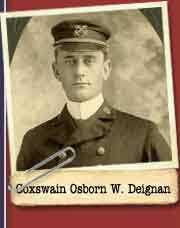
Seaman Osborn Warren Deignan (1873 – 1916)


Osborn Warren Deignan (February 24, 1873 – April 16, 1916) was an enlisted sailor and later a Warrant Officer in the United States Navy. He received his country's highest military decoration—the Medal of Honor—for actions in the Spanish-American War. Born in Iowa, he joined the Navy in 1894 and participated in the Battle of Santiago de Cuba, the largest naval engagement of the Spanish-American war. Deignan and seven others attempted to block the entrance to Santiago Harbor, Cuba but the Spanish destroyed their ship before they could accomplish their mission, and took them prisoner. The men were later released and Deignan received the Medal of Honor for his actions. He went on to become an officer and served in various posts and ships throughout the Navy until retiring in 1906. He died in Colorado in 1916, and was buried in California.
Deignan was born February 24, 1873 (as per first Navy enlistment record dated December 7, 1894) near Stuart, Iowa to John Deignan and his wife. His father had also been a sailor, serving in the Navy during the American Civil War, and afterwards went to work for the Rock Island Railway as a conductor. When Osborn was five years old, a torndado struck his father's train in Grinnel, Iowa, killing him and leaving Osborn, his mother and his brother to survive on their own. His mother remarried and the family, along with two additional children from his new stepfather, moved to North Tremont Street in Stuart. In 1887 he left school and went to sea, serving on ships in the Atlantic ocean, the Arctic and the Caribbean.
Deignan enlisted in the United States Navy from his home state of Iowa, originally on December 7, 1894 (as per first Navy enlistment record). He served on numerous USN vessels between 1894 and 1896 and, having deserted from the USS Newark on May 6, 1896 (as per naval records maintained by the Military Record Center) then re-enlistment in 1898 (as per naval records maintained by the Military Record Center.) He was assigned as a Coxswain to the USS Merrimac (1898) during the Spanish-American War. The Merrimac had frequent problems with the steering and engines, and Deignan referred to it as "cranky". After a short time on the ship, he garnered a reputation as an able helmsman and was preferred when delivering coal to the other ships in the fleet, a task that could be difficult in a ship that was already hard to control.
When Rear Admiral William T. Sampson requested volunteers for an extremely dangerous mission, there were more than enough volunteers, but he chose Osborn as the helmsman. The mission was to sink Merrimac at the entrance to Santiago Harbor, Cuba in an effort to block it and pen the Spanish Navy in the harbor. Seven other members of the crew were also chosen for the assignment. While the crew was attempting to fulfill its mission, Spanish forces fired on the ship and, in the process, disabled the Merrimac's streering controls before the crew could complete their task. The ship sank without obstructing navigation, but the crew was able to escape the ship before she went under. They were rescued by the Spanish and were taken as prisoners-of-war. A month later the Spanish fleet was destroyed at the Battle of Santiago de Cuba and the crewman were released. For his "extraordinary heroism" during the operation, Deignan was awarded the Medal of Honor.
On April 9, 1900, Deignan was promoted to the Warrant Officer rank of Boatswain. As an officer, his initial assignments were in the Philippines, first at Manila, then at the Naval Station, Cavite. After meeting her at a party in 1898, he married Maud Huntoon on May 14, 1902 and together they had a daughter. In June 1902, he reported for duty on the USS Oregon (BB-3) and later that year transferred to the receiving ship USS Independence (1814), at the Mare Island Naval Shipyard, California. He was stationed at Navy Yard, Pensacola, Florida, from 1903 through 1904, and then was assigned to the receiving ship USS Franklin (1864), at Norfolk, Virginia. He remained there for less than a year before reporting for his last tour of duty on the monitor USS Amphitrite (BM-2) in April 1905. He retired on April 21, 1906 and moved to the Los Angeles, California area.
Deignan died April 16, 1916 in Cannon City, Colorado at the age of 43 (based on birth in 1873) and was buried with full military honors at Forest Lawn Memorial Park, Glendale, California. His grave can be found in the Whispering Pines section, L-1165. Post #1842 of the Veterans of Foreign Wars was named in his honor.
Medal of Honor Citation
Rank and organization: Coxswain, U.S. Navy. Born: 24 February 1873, Sheart, Iowa. Accredited to: Iowa. G.O. No.: 529, 2 November 1899. Citation: In connection with the sinking of the U.S.S. Merrimac at the entrance to the harbor of Santiago de Cuba, 2 June 1898. Despite heavy fire from the Spanish batteries, Deignan displayed extraordinary heroism throughout this operation.

First Lieutenant Willibald C. Bianchi (1915 − 1945)


Willibald C. Bianchi (March 12, 1915 − January 9, 1945) was an officer in the Philippine Scouts who received the Medal of Honor for actions in Bataan, Philippines during that country's capitulation to Japanese forces during World War II. After the action near Bagac in the Bataan Province, Bianchi was among the troops captured by the Japanese at the fall of Bataan,on April 9, 1942. He was part of the Bataan "Death March," and was imprisoned in several Japanese prisoner of war camps, enduring horrible conditions. He was known for his compassion and efforts to better the lot of his fellow prisoners by bartering with their captors for extra food and medicine. On January 9, 1945, while imprisoned in an unmarked Japanese prison ship, Bianchi was killed instantly when an American plane, unaware that the ship contained American prisoners, dropped a 1,000-pound bomb in the cargo hold. Bianchi is one of three members of the Philippine Scouts who were awarded the Medal of Honor.
Medal of Honor Citation:

Bianchi, Willibald C. Rank and organization:First Lieutenant, U.S. Army, 45th Infantry, Philippine Scouts Place and date:Near Bagac, Bataan Province, Philippine Islands, February 3, 1942. Entered service at:New Ulm, Minnesota. Born:New Ulm, Minnesota
For conspicuous gallantry and intrepidity above and beyond the call of duty in action with the enemy on 3 February 1942, near Bagac, Province of Bataan, Philippine Islands. When the rifle platoon of another company was ordered to wipe out 2 strong enemy machine gun nests, 1st Lt. Bianchi voluntarily and of his own initiative, advanced with the platoon leading part of the men. When wounded early in the action by 2 bullets through the left hand, he did not stop for first aid but discarded his rifle and began firing a pistol. He located a machine gun nest and personally silenced it with grenades. When wounded the second time by 2 machine gun bullets through the chest muscles, 1st Lt. Bianchi climbed to the top of an American tank, manned its antiaircraft machine gun, and fired into strongly held enemy position until knocked completely off the tank by a third severe wound.

Tuesday, November 2, 2010

Major General William Frishe Dean (1899 - 1981)


William Frishe Dean, Sr. (August 1, 1899–August 24, 1981) was a Major General in the United States Army during World War II and the Korean War. He received the Medal of Honor for his actions on July 20 and 21, 1950. Dean was the highest ranking American officer captured during the Korean War.
A member of ROTC in 1920, commissioned as a Second Lieutenant in the California Army National Guard in 1921, Dean graduated from the University of California at Berkeley in 1922. He was tendered a Regular Army commission on October 18, 1923. Promoted to brigadier general in 1942 and then to major general in 1943, Dean served first as assistant division commander and later as division commander of the 44th Infantry Division.
In 1944, while serving in southern Germany and Austria, his troops captured 30,000 prisoners and helped force the surrender of the German 19th Army. He was awarded the Distinguished Service Cross for his actions.
In October 1947, he became the military governor of South Korea. He took command of the 7th Infantry Division in 1948 and moved it from Korea to Japan. After serving as Eighth U.S. Army chief of staff, he took command of the 24th Infantry Division, then headquartered at Kokura on the southern Japanese island of Kyushu, in October 1949.
When the Korean War began in June 1950, the 24th Infantry Division was the first American ground combat unit to be committed. General Dean arrived in Korea on July 3, 1950. He established his headquarters at Taejon, Korea.
His orders were to fight a delaying action against the advancing North Korean People's Army. Although he planned to withdraw from Taejon, he was asked by General Walton H. Walker, the U.S. Eighth Army Commander, to hold the city until July 20, 1950, in order to buy time to deploy other American units from Japan. His regiments had been decimated in earlier fighting, but Dean personally led tank-killer teams armed with the newly-arrived 3.5-inch rocket launchers to destroy the attacking North Korean T-34 tanks. He gained acclaim by such exploits as attacking and destroying an enemy tank armed with only a hand grenade.
The T-34 tank knocked out by General Dean in the Battle of Taejon in July 1950 was still there in 1977 as a memorial to him and the twenty-five-day battle.
On July 20, as his division fell back from Taejon, General Dean became separated from his men. Alone, he hid in woods during the day and traveled at night for over a month. On August 25, 1950, he was captured. He remained a prisoner of war of the North Koreans until his release on September 4, 1953.
In 1951, Congress voted General Dean the Medal of Honor for his actions during the defense of Taejon. The Medal was presented by President Truman on January 9, 1951 to his wife Mildred Dean, son William Dean Jr. and daughter Marjorie June Dean. Dean himself was still reported missing in action in Korea.
General Dean had no contact with the outside world until he was interviewed on December 18, 1951 by an Australian, Wilfred Burchett, who was a correspondent for Le Soir, a Belgian newspaper. This was the first time anyone had any idea he was still alive.
Dean, the highest ranking prisoner of war in the conflict, later said he had tried to commit suicide because he feared he "might squeal when they started to drive splinters under my fingernails." He had knowledge of the proposed landing at Inchon, and was worried that he might break under interrogation. He was not physically tortured, as he had feared, but was subjected to repeated interrogations that lasted up to 72 hours. He talked about inconsequential matters, later telling a Pentagon committee that, "I was trying to divert them from really starting those oriental tortures." During his third interrogation, he was prevented from committing suicide, and the interrogations stopped.
General Dean was given a hero's welcome upon his return to the United States in 1953 and showered with military and civilian honors. Dean, however, insisted he was no hero but "just a dogface soldier."
Three months after his return from Korea, Major General Dean was assigned as the Deputy Commanding General of the U.S. Sixth Army at the Presidio of San Francisco in California, where he retired. When he retired from active duty on October 31, 1955, he was, inconsistent with U.S. Army regulation, awarded the Combat Infantryman Badge for his front line service in World War II and Korea, an award he particularly cherished.
After his retirement, Dean sponsored chess tournaments in northern California and donated the General William Dean chess trophy to commemorate the general's learning to play chess while a prisoner of war in Korea.
Dean died at age 82 and was buried in San Francisco National Cemetery, San Francisco, California.
Medal of Honor citation
Rank and organization: Major General, U.S. Army, commanding general, 24th Infantry Division. Place and date: Taejon, Korea, 20 and July 21, 1950. Entered service at: California. Born: August 1, 1899, Carlyle, Ill. G.O. No.: 7, February 16, 1951.
Maj. Gen. Dean distinguished himself by conspicuous gallantry and intrepidity at the repeated risk of his life above and beyond the call of duty. In command of a unit suddenly relieved from occupation duties in Japan and as yet untried in combat, faced with a ruthless and determined enemy, highly trained and overwhelmingly superior in numbers, he felt it his duty to take action which to a man of his military experience and knowledge was clearly apt to result in his death. He personally and alone attacked an enemy tank while armed only with a hand grenade. He also directed the fire of his tanks from an exposed position with neither cover nor concealment while under observed artillery and small-arms fire. When the town of Taejon was finally overrun he refused to insure his own safety by leaving with the leading elements but remained behind organizing his retreating forces, directing stragglers, and was last seen assisting the wounded to a place of safety. These actions indicate that Maj. Gen. Dean felt it necessary to sustain the courage and resolution of his troops by examples of excessive gallantry committed always at the threatened portions of his frontlines. The magnificent response of his unit to this willing and cheerful sacrifice, made with full knowledge of its certain cost, is history. The success of this phase of the campaign is in large measure due to Maj. Gen. Dean's heroic leadership, courageous and loyal devotion to his men, and his complete disregard for personal safety.

Major Charles Joseph Loring Jr. (1918 - 1952)


Charles Joseph Loring, Jr. (October 2, 1918 – November 22, 1952) was an officer in the U.S. Air Force during the Korean War. He posthumously received the Medal of Honor for his actions on November 22, 1952. The U. S. Air Force base at Limestone, Maine was renamed Loring AFB in his honor.
Maj. Charles Joseph Loring Jr. fought in the European theatre in World War II from 1944 as a fighter pilot with the 36th Fighter Group's 22nd Squadron. He completed 55 combat missions before being shot down and taken prisoner. He was sent to Korea in May 1952 with the 36th and 80th Squadrons, 8th Fighter Bomber Group.
On November 22, 1952, Maj. Loring led his flight in dive-bombing enemy gun positions. When his plane was hit repeatedly during his attack run, Maj. Loring deliberately crashed his F-80 into the guns, destroying them.
Medal of Honor citation
Rank and organization: Major, U.S. Air Force, 80th Fighter-Bomber Squadron, 8th Fighter-Bomber Wing. Place and date: Near Sniper Ridge, North Korea, November 22, 1952, Entered service at: Portland, Maine. Born: October 2, 1918, Portland, Maine
Maj. Loring distinguished himself by conspicuous gallantry and intrepidity at the risk of his life above and beyond the call of duty. While leading a flight of 4 F-80 type aircraft on a close support mission, Maj. Loring was briefed by a controller to dive-bomb enemy gun positions which were harassing friendly ground troops. After verifying the location of the target, Maj. Loring rolled into his dive bomb run. Throughout the run, extremely accurate ground fire was directed on his aircraft. Disregarding the accuracy and intensity of the ground fire, Maj. Loring aggressively continued to press the attack until his aircraft was hit. At approximately 4,000 feet, he deliberately altered his course and aimed his diving aircraft at active gun emplacements concentrated on a ridge northwest of the briefed target, turned his aircraft 45 degrees to the left, pulled up in a deliberate, controlled maneuver, and elected to sacrifice his life by diving his aircraft directly into the midst of the enemy emplacements. His selfless and heroic action completely destroyed the enemy gun emplacement and eliminated a dangerous threat to United Nations ground forces. Maj. Loring's noble spirit, superlative courage, and conspicuous self-sacrifice in inflicting maximum damage on the enemy exemplified valor of the highest degree and his actions were in keeping with the finest traditions of the U.S. Air Force.

General Jonathan Mayhew "Skinny" Wainwright IV (1883 - 1953)


Jonathan Mayhew "Skinny" Wainwright IV (August 23, 1883 – September 2, 1953) was a career American army officer and the commander of Allied forces in the Philippines at the time of their surrender to the Empire of Japan during World War II. Wainwright is a recipient of the Medal of Honor.
Wainwright was born at Fort Walla Walla, an army post now in Walla Walla, Washington, and was the son of Robert Powell Page Wainwright, a U.S. Army officer who had served as a 2nd Lt in the US 1st Cavalry in 1875, commanded a squadron at the Battle of Santiago de Cuba during the Spanish-American War, and in 1902 was killed in action in the Philippines. His grandfather was Jonathan Mayhew Wainwright II. He graduated from Highland Park High School in 1901 and from West Point, in 1906, and was commissioned in the cavalry. He served with the U.S. 1st Cavalry Regiment in Texas from 1906–08 and in the Philippines from 1908–10, where he saw combat on Jolo, during the Moro Rebellion. Wainwright graduated from the Mounted Service School, Fort Riley, Kansas, in 1916 and was promoted to Captain. By 1917 he was on the staff of the first officer training camp at Plattsburgh, New York.
In February 1918, he was ordered to France, during World War I. In June, he became Assistant Chief-of-Staff of the U.S. 82nd Infantry Division, with which he took part in the Saint Mihiel and Meuse-Argonne Offensives. As a temporary Lieutenant Colonel, he was assigned to occupation duty in Germany with the 3rd Army at Koblenz, Germany, from October 1918 until 1920. Having reverted to the rank of Captain, he was then promoted to major.
After a year as an instructor at the Cavalry School at Fort Riley, he was attached to the General Staff from 1921–23 and assigned to the U.S. 3rd Cavalry Regiment, Fort Myer, Virginia, from 1923–25. In 1929, he was promoted to Lieutenant Colonel and graduated from the Command and General Staff School, Fort Leavenworth, Kansas, in 1931, and from the Army War College in 1934. Wainwright was promoted to Colonel in 1935, and served as commander of the 3rd Cavalry Regiment until 1938, when he was promoted to Brigadier General in command of the U.S. 1st Cavalry Regiment at Fort Clark, Texas.
In September 1940, Wainwright was promoted to Major General (temporary) and returned to the Philippines, in December, as commander of the Philippine Department. As the senior field commander of Filipino and US forces—under General Douglas MacArthur—Wainwright was responsible for resisting the Japanese invasion of the Philippines, which began in December 1941. Retreating from the Japanese beachhead of Lingayen Gulf, Allied forces had withdrawn onto the Bataan Peninsula and Corregidor by January 1942, where they defended the entrance to Manila Bay.
Following the relocation of MacArthur to Australia in March, to serve as Allied Supreme Commander, South West Pacific Area, Wainwright inherited the unenviable position of Allied commander in the Philippines. Also that March, Wainwright was promoted to Lieutenant General (temporarily). On April 9, the 70,000 troops on Bataan surrendered under the command of Major General Edward P. King. On May 5, the Japanese attacked Corregidor and on May 6, in the interest of minimizing casualties, Wainwright surrendered. By June 9, Allied forces had completely surrendered.
Wainwright was then held in prison camps in northern Luzon, Formosa, and Manchuria until his liberation by the Red Army in August 1945.[1] He was the highest-ranking American POW, and despite his rank, his treatment at the hands of the Japanese was not pleasant. After witnessing the Japanese surrender aboard the USS Missouri (BB-63) on September 2, together with Lieutenant-General Arthur Percival, he returned to the Philippines to receive the surrender of the local Japanese commander, Lieutenant-General Tomoyuki Yamashita.
Dubbed by his men a "fighting" general who was willing to get down in the foxholes, Wainwright won the respect of all who were imprisoned with him. He agonized over his decision to surrender Bataan throughout his captivity, feeling that he had let his country down. Upon release, the first question he asked was how people back in the U.S. thought of him, and was amazed when told he was considered a hero. He later received the Medal of Honor, an honor which General MacArthur opposed.
On September 5, 1945, shortly after the Japanese surrender, Wainwright received his fourth star. On September 13, a ticker-tape parade in New York City was held in his honor. Upon returning to the United States, he was assigned a corps command as commander of Second Service Corps and Fort Jay, Governors Island, New York. In January 1946, he became the commander of the Fifth United States Army at Fort Sam Houston, Texas where he retired in August 1947.
Wainwright served on the board of directors for several corporations after his retirement. He made himself available to speak before veterans' groups and filled almost every request to do so. He never felt any bitterness toward MacArthur for his actions in the Philippines or MacArthur's attempt to deny him the Medal of Honor. In fact, when it appeared that MacArthur might be nominated for president at the 1948 Republican National Convention, Wainwright stood ready to make the nominating speech.
He died of a stroke at San Antonio, Texas on September 2, 1953. Wainwright was buried in Section 1 of Arlington National Cemetery and is one of the few people to have had their funeral held in the lower level of the Memorial Amphitheater. He is buried next to his wife and near his parents.
Medal of Honor citation
Distinguished himself by intrepid and determined leadership against greatly superior enemy forces. At the repeated risk of life above and beyond the call of duty in his position, he frequented the firing line of his troops where his presence provided the example and incentive that helped make the gallant efforts of these men possible. The final stand on beleaguered Corregidor, for which he was in an important measure personally responsible, commanded the admiration of the Nation's allies. It reflected the high morale of American arms in the face of overwhelming odds. His courage and resolution were a vitally needed inspiration to the then sorely pressed freedom-loving peoples of the world.

Rear Admiral Richard Hetherington "Dick" O'Kane (1911 - 1994)


Rear Admiral Richard Hetherington “Dick” O'Kane (February 2, 1911 – February 16, 1994) was a United States Navy submarine commander in World War II, who received a Medal of Honor for his service on the USS Tang (SS-306). Having also served on the near legendary USS Wahoo (SS-238), as Executive Officer (XO) and 'Approach Officer', he participated (directly) in more successful attacks on Japanese shipping than any other fighting submarine officer during the war.
O'Kane was born in Dover, New Hampshire, graduated from the U.S. Naval Academy in May 1934 and spent his first years of active duty on the cruiser USS Chester (CA-27) and destroyer USS Pruitt (DD-347). He received submarine instruction in 1938 and was then assigned to USS Argonaut (SM-1) until 1942. Lieutenant O'Kane then joined the precommissioning crew of the new submarine Wahoo and served as her Executive Officer on five war patrols first under Lieutenant Commander Marvin G. Kennedy and later under Lieutenant Commander Dudley "Mush" Morton. Morton established a record as an excellent tactician, as he preferred to run the demanding analysis and plots while his XO manned the periscopes, a reversal of standard practices.
In July 1943, Lieutenant Commander O'Kane was detached from Wahoo and soon became Prospective Commanding Officer (PCO) of the Tang, which was then under construction. He placed her in commission in October 1943 and commanded her through her entire career. He was an innovator, and developed several operational tactics that markedly increased his ship's efficiency. Among these tactics were daylight surface cruising with extra lookouts, periscope recognition and range drills—enabling clear tactical sureness when seconds counted, and methods of night surface attacks—one of his favorite techniques to obtain and maintain the initiative in battle.
In five war patrols, O'Kane and Tang sank an officially recognized total of 24 Japanese ships. This total was revised in 1980 from a review of Japanese war records corroborated by the Tang's surviving logs and crewmembers to 31 ships totalling over 227,000 tons sunk. This established one of the Pacific War's top records for submarine achievement. Several times during the war he took the Tang into the heart of a convoy and attacked ships ahead and behind while coolly steering clear of escorting combatants—counting on Tang's relative position, speed, and low profile to keep clear of enemy escorts. He and the Tang also performed laudably on 'Lifeguard Duty', which was a practice of positioning one or more submarines off an island to be attacked by planes of the Fast Carrier Task Forces to be in a nearby close-in 'ditching station' in position to rescue downed pilots. Off Truk he and the Tang rescued 22 airmen in one mission taking some interesting risks in the process and setting an all-time record which earned a Presidential Unit Citation (US).
The Tang and O'Kane's third patrol, into the Yellow Sea, ranked first in the war patrol records for number of ships sunk in a single patrol. O'Kane claimed eight ships at the time but post-war analysis increased this to ten ships. On one attack he had targeted two large ships with three torpedoes each and assumed three hits in each. Japanese records actually reported two hits in each with the third of each spread hitting smaller ships in the next column. This surpassed the next highest patrol which was for the USS Wahoo, with O'Kane as XO, in the same area the year before.
He was captured by the Japanese when his boat was sunk in the Formosa Strait by its own flawed torpedo (running in a circle) during a surface night attack on October 24–25, 1944, wherein he lost all but eight of his crew, and was secretly (i.e. illegally) held prisoner until the war's end some ten months later. Following his release, Commander O'Kane received the Medal of Honor for his "conspicuous gallantry and intrepidity" during his submarine's final operations against Japanese shipping.
In the years following World War II, Commander O'Kane served with the Pacific Reserve Fleet as Commanding Officer of the submarine tender USS Pelias (AS-14), testified at Japanese war crimes trials, was Executive Officer of the submarine tender USS Nereus (AS-17) and was Commander Submarine Division 32. He was a student at the Armed Forces Staff College in 1950–51 and was subsequently assigned to the Submarine School at New London, Connecticut, initially as an instructor and, in 1952–53, as the Officer in Charge.
Promoted to the rank of Captain in July 1953, O'Kane commanded the submarine tender USS Sperry (AS-12) until June 1954 and then became Commander Submarine Squadron Seven. Following studies at the Naval War College in 1955–56, he served in Washington, D.C., with the Ship Characteristics Board. Captain O'Kane retired from active duty in July 1957 and, on the basis of his extensive combat awards, was simultaneously advanced to the rank of Rear Admiral on the Retired List.
O'Kane died in Petaluma, California at the age of 83. He is buried in Arlington National Cemetery, Section 59, Grave 874. His wife was later buried beside him.
Awards
In addition to the Medal of Honor, O'Kane received three Navy Crosses, three Silver Stars, the Legion of Merit with "V" device for valor, the Purple Heart and several other decorations. He wrote books about his service on Tang and Wahoo, entitled Clear the Bridge!: The War Patrols of the USS Tang and Wahoo: The Patrols of America's Most Famous World War II Submarine, respectively.
Admiral O'Kane was also awarded the American Defense Service Medal, Asiatic-Pacific Campaign Medal with 9 battle stars, World War Two Victory Medal and the National Defense Service Medal. He was also retroactively entitled to the Prisoner of War Medal and the Combat Action Ribbon.
In 1998, the Arleigh Burke-class destroyer USS O'Kane (DDG-77) was named in honor of O'Kane.
The wardroom of the oldest submarine in the fleet carries O'Kane's personal cribbage board, and upon decommissioning the board is transferred to the next oldest boat.
Medal of Honor citation
Rank and organization: Commander, United States Navy, commanding U.S.S. Tang. Place and date: Vicinity Philippine Islands, October 23, and October 24, 1944. Entered service at: New Hampshire. Born: February 2, 1911, Dover, N.H.
For conspicuous gallantry and intrepidity at the risk of his life above and beyond the call of duty as commanding officer of the U.S.S. Tang operating against 2 enemy Japanese convoys on 23 October and 24 October 1944, during her fifth and last war patrol. Boldly maneuvering on the surface into the midst of a heavily escorted convoy, Comdr. O'Kane stood in the fusillade of bullets and shells from all directions to launch smashing hits on 3 tankers, coolly swung his ship to fire at a freighter and, in a split-second decision, shot out of the path of an onrushing transport, missing it by inches. Boxed in by blazing tankers, a freighter, transport, and several destroyers, he blasted 2 of the targets with his remaining torpedoes and, with pyrotechnics bursting on all sides, cleared the area. Twenty-four hours later, he again made contact with a heavily escorted convoy steaming to support the Leyte campaign with reinforcements and supplies and with crated planes piled high on each unit. In defiance of the enemy's relentless fire, he closed the concentration of ship and in quick succession sent 2 torpedoes each into the first and second transports and an adjacent tanker, finding his mark with each torpedo in a series of violent explosions at less than 1,000-yard range. With ships bearing down from all sides, he charged the enemy at high speed, exploding the tanker in a burst of flame, smashing the transport dead in the water, and blasting the destroyer with a mighty roar which rocked the Tang from stem to stern. Expending his last 2 torpedoes into the remnants of a once powerful convoy before his own ship went down, Comdr. O'Kane, aided by his gallant command, achieved an illustrious record of heroism in combat, enhancing the finest traditions of the U.S. Naval Service.

Monday, November 1, 2010

Major Ralph Cheli (1919 - 1944


Ralph Cheli (pronounced "Kelly"; October 29, 1919—March 6, 1944) was a major in the United States Army Air Forces and a recipient of the Medal of Honor. He served as the commanding officer of the 405th Bombardment Squadron (Medium) in the Fifth Air Force's 38th Bombardment Group, based at Durand Airfield, Port Moresby, New Guinea.
On August 18, 1943, while leading his group of B-25 Mitchells on a low level attack of two Japanese airfields, his bomber was severely damaged. Cheli pressed the attack despite the battle damage, then crash-landed his bomber at sea. He was made a prisoner-of-war and on March 6, 1944, was executed by his captors. During the period when his status was unknown, Cheli was nominated for the Medal of Honor, which he was awarded in October 1943.
Born in San Francisco to Alfred and Julia Cheli, he attended Lehigh University as member of the class of 1941. In February 1940, during his junior year, he left Lehigh to enlist in the USAAF as an aviation cadet. He undertook primary flying training at Tulsa, Oklahoma; basic flight training at Randolph Field, Texas; and multi-engine advanced training at Kelly Field, Texas.
After commissioning as a second lieutenant in November, Cheli was assigned as a B-17 Flying Fortress co-pilot in the 21st Reconnaissance Squadron, operating from Miami, Florida, under the 3rd Bombardment Wing of General Headquarters Air Force. After attending the Chemical Warfare School at Edgewood Arsenal, Maryland, he rejoined the 21st RS at MacDill Field, Florida, where it had been attached to the 29th Bomb Group. When the United States entered World War II, Cheli was promoted to 1st lieutenant in February 1942 and flew anti-submarine patrols in the Caribbean Sea as a B-17 pilot with the 43rd Bomb Squadron (29th BG).
Cheli advanced to captain in June 1942 and was transferred to the 38th Bomb Group at Barksdale Field, Louisiana, where he was assigned as Operations Officer of the 405th Bomb Squadron "Green Dragons". In August Cheli led a flight of B-25s from Hamilton Field, California, to Australia in the first air movement of B-25s to the Southwest Pacific war zone. Two months later, the 38th moved forward to Port Moresby, where Cheli was assigned command of the 405th BS after the death of its previous commander on January 5, 1943. He was promoted to major in March.[2]
On March 3, 1943, during the Battle of the Bismarck Sea, Cheli led the 405th Bomb Squadron in the first daylight "masthead" (low level) attack against a Japanese shipping convoy, one of the first skip bombing raids. In all he flew 39 combat missions and earned the Distinguished Flying Cross and the Air Medal.
Medal of Honor mission
In August 1943, the Fifth Air Force was supporting the Allies' strategic plan of advance toward the Philippines along the north coast of New Guinea. Its next stage, scheduled for early September, was the seizure of the Japanese base at Lae. The immediate goal of the Fifth Air Force was the neutralization of Japanese airpower concentrated at Wewak, some 300 miles west of Lae. Wewak and its satellite fields at But, Boram, and Dagua, based more than 100 bombers and about 90 fighters. The 500+-mile flight to Wewak was the deepest penetration into Japanese-held territory yet made by medium bombers.
On the night of August 16, 50 heavy bombers attacked the fields, followed on the morning of the 17th by 32 B-25s, escorted by 80 P-38 Lightnings. Both attacks encountered intense antiaircraft fire but little fighter opposition. Another attack on the airfields was dispatched on the morning of August 18 to strafe and drop the fields from low altitude. The was assigned to attack Wewak and Boram fields, while the 38th BG was sent further west to attack Dagua and But airdromes. Each bomber was loaded with 12 3-bomb clusters of 23-pound "para-frag" bombs, which the 405th BS would drop on Dagua and the 71st BS on But.
Cheli was assigned to lead the 38th BG, 30 B-25 Mitchells including stand-bys. Bad weather en route separated the force from its P-38 cover escort, and mechanical problems reduced each squadron by one Mitchell, leaving his 405th and the following 71st Squadrons to attack with 28 B-25s. His assigned aircraft that day was B-25D-1 (s/n 41-30117), a bomber field-modified into a strafer by enclosure of its plexiglass nose to mounting of four forward-firing machine guns, and a pair of fuselage side "blister packs" mounting guns that also fired forward.
While maneuvering 150 feet above the ground to attack the heavily defended airfield, 10-15 Japanese Oscar fighters orbiting in the clouds attacked from above, making numerous passes at the force over a ten-minute span of time. Several concentrated their fire on Cheli's bomber, causing its right engine to burst into flames while still 2 miles from the target. The fire quickly spread to the nose and cockpit.
His speed would have enabled him to gain necessary altitude to parachute to safety, but this action would have resulted in his formation becoming disorganized and exposed to the enemy. Although a crash was inevitable, he elected to continue leading the attack. From a minimum altitude, the squadron made a devastating bombing and strafing attack on the target. Maj. Cheli directed his wingman to lead the formation. His aircraft flew southeast to the vicinity of Boram airfield, where it crash-landed in the sea about 2 kilometers offshore.
Initially he was believed killed in the crash, but post war evidence indicates that he survived the crash but was executed in March 1944 by the Japanese while a POW on Rabaul. For his actions, he posthumously received the Medal of Honor. What are believed to be Major Cheli's and other similarly executed POWs remains are now interred at Jefferson Barracks National Cemetery in St. Louis, Missouri.
Cheli was survived by his wife, Geraldine, and infant son, Ralph Jr. The Arnold Air Society chapter at his alma mater Lehigh University was named in his honor. Between 1947 and 1961 the United States Air Force operated the Cheli Air Force Station near Maywood, California.
Medal of Honor citation
Rank and organization: Major, U.S. Army Air Corps. Place and date: Near Wewak, New Guinea, August 18, 1943. Entered service at: Brooklyn, N.Y. Birth: San Francisco, Calif. G.O. No.: 72, October 28, 1943.
For conspicuous gallantry and intrepidity above and beyond the call of duty in action with the enemy. While Maj. Cheli was leading his squadron in a dive to attack the heavily defended Dagua Airdrome, intercepting enemy aircraft centered their fire on his plane, causing it to burst into flames while still 2 miles from the objective. His speed would have enabled him to gain necessary altitude to parachute to safety, but this action would have resulted in his formation becoming disorganized and exposed to the enemy. Although a crash was inevitable, he courageously elected to continue leading the attack in his blazing plane. From a minimum altitude, the squadron made a devastating bombing and strafing attack on the target. The mission completed, Maj. Cheli instructed his wingman to lead the formation and crashed into the sea.

Thursday, October 28, 2010

Capt Lance P. Sijan 1942-1968


Lance P. Sijan was the first graduate of the U.S. Air Force Academy to receive the Medal of Honor, posthumously, for heroism above and beyond the call of duty. His spirit and determination inspired a fellow prisoner of war to nominate him.

Sijan was born in April 1942 and graduated from Bay View High School in Milwaukee, Wisconsin. He originally planned to attend the Naval Academy. However, he was attracted to the prestige and quality education of the Air Force school, plus he had developed a love of flying. He played football but quit the team in his senior year to concentrate more on his studies. After graduation in 1965 from the academy he attended pilot training where he received an F-4 Phantom II assignment. Eventually he was assigned to the 366th Fighter Wing, at Da Nang Air Base, Vietnam.

On November 9, 1967, while on his 52nd mission, 25-year-old Sijan ejected from his F-4C after it was hit over North Vietnam. A search-and-rescue Jolly Green helicopter radioed to Sijan that they were going to lower someone to assist him. Sijan refused to put another person in danger and asked that a penetrator be lowered instead. However, he couldn't grab the dropped steel cable and after thirty-three minutes the rescue team, facing heavy enemy fire, had to depart.

Even with no food and very little water, Lance managed to avoid capture for forty-five days. Because of a serious compound fracture of the left leg, he was unable to walk but did manage to pull himself backward through the jungle. After his initial capture, in spite of the broken leg and now a skull fracture and mangled right hand, he was able to escape. Once recaptured he was taken to Vinh and thrown into a bamboo cell. He was 'interrogated' repeatedly and, despite his captor’s technique of twisting his damaged right hand, he refused to disclose any information but his name.

Sijan was soon moved to a POW camp at Hanoi. Even in his emaciated condition, he attempted more escapes, all meeting with failure. His physical condition continued to weaken without proper food or medical attention. In January 1968, he developed additional respiratory problems including pneumonia. After many months of ill treatment, his health broke. Sijan was removed from his cell during the night of January 21, 1968 and, according to his Vietnamese captors, died the following day at Hoa Lo's "Hanoi Hilton."

He was promoted posthumously to captain on June 13, 1968. On March 4, 1976 President Gerald Ford presented the Medal of Honor to his parents, Sylvester and Jane Sijan.
The U.S. Air Force Academy named Sijan Hall, a cadet dormitory, in honor of him on May 31, 1976. Additionally, the U.S. Air Force honors Air Force personnel who exhibit the highest example of professional and personal leadership standards with the Lance P. Sijan Award.

Medal of Honor Citation

Rank and organization: Captain, U.S. Air Force, 4th Allied POW Wing, Pilot of an F-4C aircraft. Place and date: North Vietnam, 9 November 1967. Entered service at: Milwaukee, Wis. Born: 13 April 1942, Milwaukee, Wis. Citation: While on a flight over North Vietnam, Capt. Sijan ejected from his disabled aircraft and successfully evaded capture for more than 6 weeks. During this time, he was seriously injured and suffered from shock and extreme weight loss due to lack of food. After being captured by North Vietnamese soldiers, Capt. Sijan was taken to a holding point for subsequent transfer to a prisoner of war camp. In his emaciated and crippled condition, he overpowered 1 of his guards and crawled into the jungle, only to be recaptured after several hours. He was then transferred to another prison camp where he was kept in solitary confinement and interrogated at length. During interrogation, he was severely tortured; however, he did not divulge any information to his captors. Capt. Sijan lapsed into delirium and was placed in the care of another prisoner. During his intermittent periods of consciousness until his death, he never complained of his physical condition and, on several occasions, spoke of future escape attempts. Capt. Sijan's extraordinary heroism and intrepidity above and beyond the call of duty at the cost of his life are in keeping with the highest traditions of the U.S. Air Force and reflect great credit upon himself and the U.S. Armed Forces.

Colonel George Everette "Bud" Day


Colonel Bud Day - Ex-POW & Recipient of the Medal of Honor - On Torture
"I didn't expect to be reminded of my treatment some 36 years ago on this holiday weekend but our politicians find it worthy to ignore what some have tried to recount to them, who have actually been there."

I was shot down over North Vietnam in 1967...a squadron commander.

After I returned in 1973, I published two books that dealt a lot with "real torture" in Hanoi. Our make believe president is branding our country as a bunch of torturers when he has no idea what torture is.

As for me..put thru a mock execution because I would not respond...pistol whipped on the head...same event. Couple of days later...hung by my feet all day. I escaped and got recaptured a couple of weeks later...I got shot and recaptured. Shot was okay...what happened after was not.

They marched me to Vinh...put me in the rope trick, trick...almost pulled my arms out of the sockets. Beat me on the head with a little wooden rod until my eyes were swelled shut, and my unshot, unbroken hand a pulp.

Next day hung me by the arms...rebroke my right wrist...wiped out the nerves in my arms that control the hands..rolled my fingers up into a ball. Only left the slightest movement of my left forefinger. So I started answering with some incredible lies.

Sent me to Hanoi strapped to a barrel of gas in the back of a truck.

Hanoi...on my knees...rope trick again. Beaten by a big fool.

Into leg irons on a bed in Heartbreak Hotel.

Much kneeling--hands up at Zoo.

Really bad beating for refusing to condemn Lyndon Johnson.

Several more kneeling events. I could see my knee bone thru kneeling holes.

There was an escape from the annex to the Zoo. I was the Senior Officer of a large building because of escape...they started a mass torture of all commanders.

I think it was July 7, 1969...they started beating me with a car fan belt. In first two days I took over 300 strokes...then stopped counting because I never thought I would live thru it.

They continued day-night torture to get me to confess to a non-existent part in the escape. This went on for at least 3 days. On my knees...fan belting...cut open my scrotum with fan belt stroke...opened up both knee holes again. My fanny looked like hamburger...I could not lie on my back.

They tortured me into admitting that I was in on the escape...and that my two room-mates knew about it.

The next day I denied the lie.

They commenced torturing me again with 3, 6, or 9 strokes of the fan belt every day from about July 11 or 12th...to 14 October 1969. I continued to refuse to lie about my roommates again.

Now, the point of this is that our make-believe president has declared to the world that we ( U.S. ) are a bunch of torturers. Thus it will be okay to torture us next time when they catch us...because that is what the U.S. does.

Our make-believe president is a know nothing fool who thinks that pouring a little water on some one's face, or hanging a pair of womens pants over an Arabs head is TORTURE. He is a meathead.

I just talked to MOH holder Leo Thorsness who was also in my squad in jail...as was John McCain...and we agree that McCain does not speak for the POW group when he claims that Al Gharib was torture...or that "water boarding" is torture.

Our president and those fools around him who keep bad mouthing our great country are a disgrace to the United States. Please pass this info on to Sean Hannity. He is free to use it to point out the stupidity of the claims that water boarding...which has no after effect...is torture. If it got the Arab to cough up the story about how he planned the attack on the twin towers in NYC...hurrah for the guy who poured the water.


George Everette "Bud" Day (born February 24, 1925) is a retired U.S. Air Force Colonel and Command Pilot who served during the Vietnam War, to include five years and seven months as a Prisoner of War in North Vietnam. He is often cited as being the most decorated U.S. service member since General Douglas MacArthur, having received some seventy decorations, a majority for actions in combat. Day is a recipient of the Medal of Honor.
Day was born in Sioux City, Iowa, on February 24, 1925. In 1942 he quit high school and enlisted in the United States Marine Corps. He served 30 months in the North Pacific during World War II as a member of a 5 in (130 mm) gun battery with the 3rd Defense Battalion on Johnston Island.
After the war, Day attended Morningside College on the G.I. Bill, earning a Bachelor of Science Degree, followed by law school at the University of South Dakota, receiving a Juris Doctor. Day passed the bar exam in 1949 and was admitted to the bar in South Dakota. In later life, Day was also awarded a Master of Arts degree from St. Louis University, a Doctor of Humane Letters from Morningside, and a Doctor of Laws from Troy State University. Day was admitted to the Florida Bar in 1977.
A member of the Army Reserve, in 1950 he received a direct commission as a Second Lieutenant in the Iowa Air National Guard, and was called to active duty in 1951 for Undergraduate Pilot Training in the U.S. Air Force. He served two tours as a fighter-bomber pilot during the Korean War flying the Republic F-84 Thunderjet, surviving a "no-chute" ejection in 1955. Promoted to captain, he decided to make the Air Force a career and was augmented into the Regular Air Force. He then transitioned to the F-100 Super Sabre in 1957 while stationed at RAF Wethersfield.
Anticipating retirement in 1968 and now a major, Day volunteered for a tour in Vietnam and was assigned to the 31st Tactical Fighter Wing at Tuy Hoa Air Base in April 1967. At that time he had more than 5,000 flying hours, with 4,500 of them in fighters. On June 25, 1967, with extensive previous service flying two tours in F-100s, Major Day was made the first commander of Detachment 1, 416th Tactical Fighter Squadron, 37th Tactical Fighter Wing based at Phu Cat Air Base. Under the project name "Commando Sabre", twin-seat USAF F-100Fs were evaluated as a Fast Forward Air Control ("Fast FAC") aircraft in high threat areas, given that F-4 Phantom II aircraft were in high demand for strike and Combat Air Patrol (CAP) roles. Using the call sign Misty, the name of Day's favorite song, his detachment of four two-seat F-100Fs and 16 pilots became pioneer "Fast FACs" (Forward Air Controllers) over Laos and North Vietnam. All Misty FAC crews were volunteers with at least 100 combat missions in Vietnam and 1,000 minimum flight hours. Tours in Commando Sabre were temporary and normally limited to four months or about 50-60 missions.

Prisoner of war
On August 26, 1967, Major Day was flying F-100F-15-NA, AF Serial No. 56-3954, call sign "Misty 01", on his 26th Fast FAC sortie, directing a flight of F-105 Thunderchiefs in an air strike against a surface-to-air missile (SAM) site north of Thon Cam Son and west of Dong Hoi, 20 mi (32 km) north of the DMZ in North Vietnam. Day was on his 65th mission into North Vietnam and acting as check pilot for Captain Corwin M. "Kipp" Kippenhan, who was upgrading to aircraft commander. 37 mm antiaircraft fire crippled the aircraft, forcing the crew to eject. In the ejection, Day's right arm was broken in three places when he struck the side of the cockpit, and he also experienced eye and back injuries.
Kippenhan was rescued by a USAF HH-3E, but Day was unable to contact the rescue helicopter by survival radio and was quickly captured by North Vietnamese local militia. On his fifth night, when he was still within 20 mi (32 km) of the DMZ, Day escaped from his initial captors despite his serious injuries. Although stripped of both his boots and flight suit, Day crossed the Demilitarized Zone back into South Vietnam, becoming the only U.S. prisoner of war to escape from North Vietnam. Within 2 mi (3 km) of the U.S. Marine firebase at Con Thien and after 12–15 days of evading, he was captured again, this time by a Viet Cong patrol that wounded him in the leg and hand with gunfire.
Taken back to his original camp, Day was tortured for escaping, breaking his right arm again. He then was moved to several prison camps near Hanoi, where he was periodically beaten, starved, and tortured. In December 1967, Day shared a cell with Navy Lieutenant Commander and future Senator and Presidential Candidate John McCain who was even more seriously injured and emaciated. Air Force Major Norris Overly nursed both back to health, and McCain later devised a makeshift splint of bamboo and rags that helped heal Day's seriously atrophied arm.[4]
On March 14, 1973, Day was released after five years and seven months as a North Vietnamese prisoner. Within three days Day was reunited with his wife, Doris Sorensen Day, and four children at March Air Force Base, California. On March 4, 1976, President Gerald Ford awarded Day the Medal of Honor for his personal bravery while a captive in North Vietnam.
Day had been promoted to Colonel while a prisoner, and decided to remain in the Air Force in hopes of being promoted to Brigadier General. Although initially too weak to resume operational flying, he spent a year in physical rehabilitation and with 13 separate medical waivers, was returned to active flying status. He underwent conversion training to the F-4 Phantom II and was appointed vice commander of the 33rd Tactical Fighter Wing at Eglin Air Force Base, Florida.

Retirement
After being passed over for nomination to brigadier general, Day retired from active duty in 1977 to resume his practice of law in Florida. At his retirement he had nearly 8,000 total flying hours, 4,900 in single engine jets, and had flown the F-80 Shooting Star, F-84 Thunderjet, F-100 Super Sabre, F-101 Voodoo, F-104 Starfighter, F-105 Thunderchief, F-106 Delta Dart, F-4 Phantom II, A-4 Skyhawk, A-7 Corsair II, CF-5 Tiger, F-15 Eagle jet fighters.
Following his retirement, Day wrote an autobiographical account of his experiences as a prisoner of war, Return with Honor, followed by Duty, Honor, Country, which updated his autobiography to include his post-Air Force years. Among other endeavors, in 1996 Day filed a class action lawsuit for breach of contract against the United States government on behalf of military retirees who were stripped of their military medical care benefits at age 65 and told to apply for Medicare. Although winning the case in the district court in 2001, the judgment against the U.S. was overturned by the U.S. Court of Appeals in 2002. The U.S. Congress later redressed this situation by establishing the "TRICARE For Life" (TFL) program, which restored TRICARE military medical benefits for career military retirees over the age of 65, making the retirees eligible for both programs with Medicare as the primary payer and TRICARE as the secondary payer.

Political activity and controversy
Day is an active member of the Florida Republican Party, was involved in the 527 group Swift Vets and POWs for Truth, and campaigned with John McCain in 2000 and 2008. In the months leading up to the 2004 U.S. presidential election, Day appeared in television advertisements—along with other members of the 527 group Swift Vets and POWs for Truth—decrying John Kerry's anti-war activities following his military service during the Vietnam War and declaring him "unfit" for service and of a "dishonest" disposition for comments and actions made by Kerry after the Vietnam War, including his testimony at the Winter Soldier Conference in Washington, D.C. During a 2008 teleconference with reporters from the Miami Herald, Day made comments regarding John McCain's stance on the Iraq War, stating that "I don't intend to kneel, and I don't advocate to anybody that we kneel, and John [McCain] doesn't advocate to anybody that we kneel." Also during this interview he sparked controversy by making a broad generalization about what some see as an ideological divide between Islam and America: "the Muslims have said either we kneel, or they're going to kill us." In the same interview when questioned about the role of 527 organizations in contemporary American politics, particularly his work for the Swift Boat Veterans for Truth, Day stated "the bottom line is this: 527 groups can do very effective, truthful things, and the Swift Boat attack was totally truthful."

Awards and decorations
Medal of Honor, Air Force Cross, Distinguished Service Medal, Silver Star, Legion of Merit, Distinguished Flying Cross, Bronze Star with Combat "V" for Valor and three Oak Leaf Clusters (three Bronze Star Medals for "Valor" and one Bronze Star Medal), Defense Meritorious Service Medal, Air Medal with nine Oak Leaf Clusters, Purple Heart with three Oak Leaf Clusters, Prisoner of War Medal, Presidential Unit Citation (three awards), Air Force Outstanding Unit Award with Combat "V" for Valor (four awards), Combat Readiness Medal, Marine Corps Good Conduct Medal, Army Good Conduct Medal, American Campaign Medal, Asiatic-Pacific Campaign Medal, World War II Victory Medal, National Defense Service Medal (2 awards), Korean Service Medal, Vietnam Service Medal with 14 campaign stars, Air Force Longevity Service Award, 5 oak leaf clusters, Armed Forces Reserve Medal, Small Arms Expert Marksmanship Medal, National Order of Vietnam, United Nations Service Medal, Vietnam Gallantry Cross with Palm (individual award), Vietnam Gallantry Cross (unit citation), Republic of Vietnam Campaign Medal

Air Force Cross citation
The Air Force Cross is presented to George Everett Day, Colonel, United States Air Force, for extraordinary heroism in military operations against an opposing armed force as a Prisoner of War in North Vietnam from 16 July 1969 to 14 October 1969. During this period, Colonel Day was subjected to maximum punishment and torture by Vietnamese guards to obtain a detailed confession of escape plans, policies, and orders of the American senior ranking officer in the camp, and the communications methods used by the Americans interned in the camp. Colonel Day withstood this punishment and gave nothing of value to the Vietnamese, although he sustained many injuries and open wounds to his body. Through his extraordinary heroism and willpower, in the face of the enemy, Colonel Day reflected the highest credit upon himself and the United States Air Force.

Medal of Honor citation
Citation: On 26 August 1967, Col. Day was forced to eject from his aircraft over North Vietnam when it was hit by ground fire. His right arm was broken in 3 places, and his left knee was badly sprained. He was immediately captured by hostile forces and taken to a prison camp where he was interrogated and severely tortured. After causing the guards to relax their vigilance, Col. Day escaped into the jungle and began the trek toward South Vietnam. Despite injuries inflicted by fragments of a bomb or rocket, he continued southward surviving only on a few berries and uncooked frogs. He successfully evaded enemy patrols and reached the Ben Hai River, where he encountered U.S. artillery barrages. With the aid of a bamboo log float, Col. Day swam across the river and entered the demilitarized zone. Due to delirium, he lost his sense of direction and wandered aimlessly for several days. After several unsuccessful attempts to signal U.S. aircraft, he was ambushed and recaptured by the Viet Cong, sustaining gunshot wounds to his left hand and thigh. He was returned to the prison from which he had escaped and later was moved to Hanoi after giving his captors false information to questions put before him. Physically, Col. Day was totally debilitated and unable to perform even the simplest task for himself. Despite his many injuries, he continued to offer maximum resistance. His personal bravery in the face of deadly enemy pressure was significant in saving the lives of fellow aviators who were still flying against the enemy. Col. Day's conspicuous gallantry and intrepidity at the risk of his life above and beyond the call of duty are in keeping with the highest traditions of the U.S. Air Force and reflect great credit upon himself and the U.S. Armed Forces.