Medal of Honor

Medal of Honor
Showing posts with label Enlisted. Show all posts

Monday, December 6, 2010

Bernard Harley (1842 - 1886)

Bernard Harley
Birth: 1842
Place of Birth: Brooklyn,
Home of record: New York,
Status: POW
Death: Jan. 15, 1886
Ordinary Seaman, U.S. Navy., US Picket Boat No. 1, 27 October 1864

Civil War Congressional Medal of Honor Recipient. He was a prisoner of war. He served as an Ordinary Seaman in the Union Navy. He was awarded the CMOH for action off Plymouth, North Carolina. His citation reads "Harley served on board the U.S. Picket Boat No. 1, in action, 27 October 1864, against the Confederate ram Albemarle, which had resisted repeated attacks by our steamers and had kept a large force of vessels employed in watching her. The picket boat, equipped with a spar torpedo, succeeded in passing the enemy picket within 20 yards without being discovered and then made for the Albemarle under a full head of steam, Immediately taken under fire by the ram, the small boat plunged on, jumped the log boom which encircled the target and exploded its torpedo under the port bow of the ram. The picket boat was destroyed by enemy fire and almost the entire crew taken prisoner or lost."

Medal of Honor Citation:

The President of the United States of America, in the name of Congress, takes pleasure in presenting the Medal of Honor to Ordinary Seaman Bernard Harley, United States
New York New York Navy, for extraordinary heroism in action while serving on board the U.S. Picket Boat No. 1, in action near Plymouth, North Carolina, 27 October 1864, against the Confederate ram Albemarle, which had resisted repeated attacks by our steamers and had kept a large force of vessels employed in watching her. The picket boat, equipped with a spar torpedo, succeeded in passing the enemy pickets within 20 yards without being discovered and then made for the Albemarle under a full head of steam. Immediately taken under fire by the ram, the small boat plunged on, jumped the log boom which encircled the target and exploded its torpedo under the port bow of the ram. The picket boat was destroyed by enemy fire and almost the entire crew taken prisoner or lost.

Lorenzo Denning (1843 - 1865)

Lorenzo Denning
Date of birth: September 6, 1843 at Granby, CT
Home of record: New Britain,
Entered Service in the US Navy from New Britain, CT
Status: POW
Landsman, U.S. Navy., US Picket Boat No. 1, 27 October 1864
Earned The Medal of Honor During the Civil War For heroism October 27, 1864 at Plymouth, NC
Died: February 08, 1865 at the age of 21

Lorenzo Denning died in a POW camp before presentation of his award.
Landsman Lorenzo Denning was one of seven members of the crew of the U.S. Picket Boat No. 1 awarded the Medal of Honor for personal courage in action against the Confederate ram Albemarle, which had resisted repeated attacks by our steamers and had kept a large force of vessels employed in watching her. The picket boat, equipped with a spar torpedo, succeeded in passing the enemy pickets within 20 yards without being discovered and then made for the Albemarle under a full head of steam. Immediately taken under fire by the ram, the small boat plunged on, jumped the log boom which encircled the target and exploded its torpedo under the port bow of the ram. The picket boat was destroyed by enemy fire and almost the entire crew taken prisoner or lost. Landsman Denning was killed in this action.

Medal of Honor Citation

The President of the United States of America, in the name of Congress, takes pride in presenting the Medal of Honor (Posthumously) to Landsman Lorenzo Denning, United States
Connecticut Navy, for extraordinary heroism in action while serving on board the U.S. Picket Boat No. 1 in action near Plymouth, North Carolina, 27 October 1864, against the Confederate ram Albemarle which had resisted repeated attacks by our steamers and had kept a large force of vessels employed in watching her. The picket boat, equipped with a spar torpedo, succeeded in passing the enemy pickets within 20 yards without being discovered and then made for the Albemarle under a full head of steam. Immediately taken under fire by the ram, the small boat plunged on, jumped the log boom which encircled the target and exploded its torpedo under the port bow of the ram. The picket boat was destroyed by enemy fire and almost the entire crew taken prisoner or lost.

Wednesday, November 24, 2010

Richard Gerrish Stout (1836 – 1896)


Richard Stout (1836 – August 6, 1896) was a Union Navy sailor during the American Civil War and a recipient of the United States military's highest decoration, the Medal of Honor for his actions at the Battle of Stono River.
On January 30, 1863, Stout was serving as a Landsman on the USS Isaac Smith when his ship was ambushed and captured by Confederate forces while operating on the Stono River in South Carolina. For his conduct during this action, in which he was badly wounded, Stout was awarded the Medal of Honor on April 16, 1864.
Stout died at age 59 or 60 and was buried in Evergreen Cemetery, Owego, New York


Union Sailor Lost His Right Arm and Won the Medal of Honor Landsman Richard Stout was honored for his sacrifice and service. by Berry Craig in O&P BUSINESS NEWS November 1, 2010

Confederate artillerymen did more than disable the gunboat U.S.S Isaac Smith. They shot off sailor Richard Stout’s right arm.

It looked like Stout would bleed to death. But he ignored an order to seek medical aid.

“He managed with the assistance of a comrade to stop the rapid discharge of blood from his wound, and with the crippled arm stayed at his post and fought until the Smith surrendered,” according to Deeds of Valor: How America’s Heroes Won the Medal of Honor, a book published in 1902.

Firsthand account

Landsman Stout lost his limb, but not his life, on Jan. 30, 1863, in an artillery ambush on the Stono River near Charleston, S.C. The Smith had been sent upriver to scout for the enemy.
The Smith was part of a Union fleet that was blockading the Carolina coast around Charleston. She and another gunboat, the U.S.S. McDonough, were based in Stono Inlet.

The Smith was a 450-ton, cannon- bristling, converted Hudson River pleasure steamer. She was shot up and captured just upriver from the town of Legareville, S.C., Deeds of Valor read.

“Arriving in this locality late in the afternoon, the vessel was suddenly and unexpectedly attacked by several batteries of siege and field guns hidden in the woods bordering the river banks,” the narrative explained. “The Isaac Smith had just anchored opposite Grimball’s plantation, when the rebels opened fire.”

The Smith had a lookout atop her mast but he failed to see the camouflaged gun emplacements. The Smith’s captain, Acting Lieutenant F.S. Conover, “…engaged the enemy at once,” the book read. “As the Federal vessel’s battery was inadequate to silence the hostile batteries, she tried to escape down the river, being exposed to the guns of two batteries for the distance of a mile and a half.

“When abreast of one of the batteries, some 200 yards off, a shot disabled her engine, and the vessel grounded. Eight men had been killed and 17 wounded, some of them mortally.”

Under fire

In an official report of the battle, Conover reported that he “saw immediately that we were trapped, and that my only course was to get the vessels below the batteries if possible, and fight them with a more even chance of success. For upward of a mile, on account of a bend in the river, we were obliged to receive the raking fire of between 20 and 30 guns without being able to reply, except occasionally with our pivot.”

The “pivot” was a large rifled cannon mounted on a carriage that swiveled. The vessel also carried eight smaller smooth bore guns.

“As soon as our broadside could be brought to bear, we opened upon the enemy with shell and grape, from 200 to 400 yards distant,” Conover added. “At one time I had hopes of getting by without any very serious loss, but a shot in our steam chimney effectually stopped the engine, and with no wind, little tide, and boats riddled with shot, we were left entirely at the mercy of the enemy. Under these circumstances, with the fire of some 30 guns, according to their own account … and a large body of riflemen concentrated upon us, with the shot tearing through the vessel in every direction, and with no hope of being able to silence such a fire, I deemed it my duty to surrender. Had it not been for the wounded men, with whom the berth deck was covered, I might have blown up or sunk the ship, letting the crew take their chance of getting on shore by swimming, but under the circumstances I had no alternative left me. I need hardly say ... that the order to haul down the colors was the most difficult and heartrending one I ever gave. We had 8 men killed and 17 wounded, one of whom…died soon after being removed from the vessel.”
Meanwhile, the McDonough rushed to the aid of her stricken sister. She arrived too late; the Smith was surrendering.

“Three heavy field batteries were firing upon the McDonough, and she had to retire,” Deeds of Valor read. “So the Isaac Smith fell into the enemy’s hand, and all her survivors became prisoners of war.”

Reward for service

Also in his report, Conover praised Stout as one his “men who behaved particularly well” under fire. He noted that the sailor “lost [his] right arm.”
The Navy awarded Stout the Medal of Honor on April 16, 1864. The citation reads: “Serving on board the U.S.S. Isaac Smith, Stono River, 30 January 1863. While reconnoitering on the Stono River on this date the U.S.S. Isaac Smith became trapped in a rebel ambush. Fired on from two sides, she fought her guns until disabled. Suffering heavy casualties and at the mercy of the enemy who was delivering a raking fire from every side, she struck her colors out of regard for the wounded aboard, and all aboard were taken prisoners. Carrying out his duties bravely through this action, Stout was severely wounded and lost his right arm while returning the rebel fire.”

Long life

The Rebels repaired the Smith and renamed her, the Stono.
In June 1863, the steamer, loaded with cotton, crashed into a Charleston harbor breakwater trying to run the Union blockade. Apparently, the Confederates burned the ship when they abandoned Charleston shortly before the war ended in 1865.
In the 1870s and 1880s, Smith returned to the water as a steamboat pilot transporting tourists to and from Hiawatha Island in the Susquehanna River between Owego and Apalachin, N.Y. The island was a popular holiday destination.
Stout steered the steamer Owego on its first trip to the island – June 16, 1874, according to Karen Bernardo, an Owego librarian.

“The steamboat was extremely fancy, with chandeliers, marble tables, and carpeting … Food was served on the island in ‘Hiawatha’s Wigwam’ and a dance band played tunes. Captain Truman, one of the stockholders in the company [that operated the boat] was in charge of the steamboat but Richard Stout manned the wheel,” Bernardo said.
She added that eventually a hotel called the Hiawatha House was built on the island. In 1884, a new steamboat, the Marshland, was built to haul passengers. To help provide more docking space for the new boat, Stout was hired to build a wing dam in the river, according to Hiawatha Island: Jewel of the Susquehanna, a book by Emma Sedore.

Stout died on Aug. 6, 1896, 33 years after losing his arm. He was 59 or 60 years old. Though was born in 1836, his birth day is apparently unknown. The ex-sailor was buried in Owego’s Evergreen Cemetery, where a special Medal of Honor footstone marks his grave.

“Obviously Richard Stout’s disability didn’t disable him at all, and he lived a long and productive life on the river,” Bernardo said.


Medal of Honor Citation

Rank and organization: Landsman, U.S. Navy. Born: 1836, New York. Accredited to: New York. G.O. No.: 32, April 16, 1864. Citation: Serving on board the U.S.S. Isaac Smith, Stono River, 30 January 1863. While reconnoitering on the Stono River on this date the U.S.S. Isaac Smith became trapped in a rebel ambush. Fired on from two sides, she fought her guns until disabled. Suffering heavy casualties and at the mercy of the enemy who was delivering a raking fire from every side, she struck her colors out of regard for the wounded aboard, and all aboard were taken prisoners. Carrying out his duties bravely through this action, Stout was severely wounded and lost his right arm while returning the rebel fire

Monday, November 8, 2010

Joseph S Keen (1843 - 1926)


Joseph S Keen was born July 24, 1843 at Stanford-in-the-Vale, England. Joseph was a farmer by occupation and an officer of the Detroit Oak Belting Company.

Keen enlisted as a private, for three years, in Company D, 13th Michigan Infantry at Detroit on February 1, 1862. He was mustered in on February 27th. Joseph was twice promoted: to Corporal, August 31, 1862, and Sergeant on April 1, 1863.

Joseph was wounded and taken prisoner at Chickamauga, Georgia on September 20, 1863. He was confined in the Confederate prisons at Richmond, Danville and Andersonville. He escaped on September 10, 1864 at Macon, Georgia. Following the escape and during the period of his attempt to return to Union lines Keen observed the movement of General Hood’s forces (40,000 Confederate soldiers) crossing the Chatahoochee River to flank Sherman’s army in the rear. Keen boldly walked through the Confederate marching columns, camps and pickets. He reached Union lines near Atlanta on October 1, and reported to General Kirkpatrick.

Keen was awarded the Congressional Medal of Honor on July 31, 1899 for carrying and reporting information on enemy troop movements near the Chatahoochie River.

Joseph S. Keen died of heart disease on December 6, 1926.
Medal of Honor Citation


Rank and organization: Sergeant, Company D, 13th Michigan Infantry. Place and date: Near Chattahoochee River, Ga., 1 October 1864. Entered service at: Detroit, Mich. Born: 24 July 1843, England. Date of issue: 4 August 1899. Citation: While an escaped prisoner of war within the enemy's lines witnessed an important movement of the enemy, and at great personal risk made his way through the enemy's lines and brought news of the movement to Sherman's army.

Friday, November 5, 2010

Machinist Mate 1st Class George F. Phillips, USN, (1862-1904)


Chief Machinist (?) George F. Phillips, USN, (1862-1904)
George Frederick Phillips was born on 8 March 1862 in St. John, New Brunswick, Canada. He enlisted in the US Navy from Galveston, Texas and served as a Machinist First Class in the collier Merrimac during the Spanish-American War. Phillips remained with her as one of eight volunteer crew members when Rear Admiral William T. Sampson ordered Merrimac sunk to block the entrance of Santiago Harbor, Cuba. On the night of 2-3 June 1898, during the courageous attempt to execute this mission, Merrimac's steering gear was disabled by enemy gunfire, and she sank without obstructing navigation. Her crewmen were rescued by the Spanish and made prisoners-of-war. After the Battle of Santiago de Cuba destroyed the Spanish fleet a month later, Phillips and his shipmates were released. For his "extraordinary heroism" during this operation, he was awarded the Medal of Honor.
George F. Phillips may have remained in the Navy after the Spanish-American War, since one published source on the Medal of Honor states that his highest rank was Chief Machinist (a warrant officer rank). However, no mention of him could be located in any Navy Register or Navy Reserve Register from 1899 to 1957. The same source reports that he died on 4 June 1904 in Cambridge, Massachusetts and is buried at Fernhill Cemetery, St. John, New Brunswick.

Medal o Honor Citation

Rank and organization: Machinist First Class, U.S. Navy. Born: 9 March 1864, Boston, Mass. Accredited to: New York. G.O. No.: 529, 2 November 1899. Citation: In connection with the sinking of the U.S.S. Merrimac at the entrance to the harbor of Santiago de Cuba 2 June 1898. Despite heavy fire from the Spanish shore batteries, Phillips displayed extraordinary heroism throughout this operation.

Coxswain John Edward Murphy (1869 – 1941)


John Edward Murphy (May 3, 1869 – April 9, 1941) was a United States Navy sailor and a recipient of America's highest military decoration—the Medal of Honor—for his actions in the Spanish-American War.
Murphy enlisted in the U.S. Navy from New York and served in the battleship USS Iowa (BB-4) as a coxswain during the Spanish-American War. Coxswain Murphy was one of eight volunteer crew members of the collier USS Merrimac (1898), which Rear Admiral William T. Sampson ordered sunk to block the entrance of Santiago Harbor, Cuba. On the night of June 2/3, 1898, during the attempt to execute this mission, Merrimac's steering gear was disabled by enemy gunfire, and she sank without obstructing navigation. Her crewmen were rescued by the Spanish and made prisoners-of-war. After the Battle of Santiago de Cuba destroyed the Spanish fleet a month later, Murphy and his shipmates were released. For their part in this operation, all eight men were awarded Medals of Honor.
On June 15, 1898, while he was still in Spanish custody, Murphy was promoted to the warrant officer rank of Boatswain. In October 1898, Murphy was assigned to the battleship USS Oregon (BB-3), which soon went to the Asiatic Station. He reported for training duty on board USS Pensacola (1859) in September 1901 and several months later began similar service in USS Constellation (1854). In the Summer of 1903 he was assigned to the armored cruiser USS New York (ACR-2) in the Pacific Squadron. Murphy was promoted to Chief Boatswain on June 15, 1904. For his last tour, he served in USS Buffalo (1892), also in the Pacific, and was placed on the retired list on August 1, 1905.
Chief Boatswain John Edward Murphy died at age 71 and was buried at Fort Rosecrans National Cemetery, San Diego, California. His grave can be found in the officer's section, grave 363 GPS (lat/lon): 32.41418, -117.14673.
Medal of Honor citation
Coxswain Murphy's official Medal of Honor citation reads: In connection with the sinking of the U.S.S. Merrimac at the entrance to the harbor of Santiago de Cuba, 2 June 1898. Despite heavy fire from the Spanish shore batteries, Murphy displayed extraordinary heroism throughout this operation.

Chief Master-At-Arms Daniel Montague (1867 – 1912)


Daniel Montague (October 22, 1866 or 1867 – February 4, 1912) was a United States Navy sailor and a recipient of America's highest military decoration—the Medal of Honor—for his actions in the Spanish-American War.
Daniel Montague enlisted in the Navy during the mid-1890s and served in USS New York (ACR-2) during the Spanish-American War as a Chief Master-at-Arms. He was one of eight volunteer crew members of the collier USS Merrimac, which Rear Admiral William T. Sampson ordered sunk to block the entrance of Santiago Harbor, Cuba. On the night of 2-June 3, 1898, during the attempt to execute this mission, Merrimac's steering gear was disabled by enemy gunfire, and she sank without obstructing navigation. Her crewmen were rescued by the Spanish and made prisoners-of-war. After the Battle of Santiago de Cuba destroyed the Spanish fleet a month later, Montague and his shipmates were released. For their actions during this operation, all eight men were awarded the Medal of Honor.
Montague was promoted to the warrant officer rank of Boatswain on June 15, 1898, while he was still in Spanish custody. His initial post-war assignment, to the training ship Lancaster, lasted from August 1898 to late in 1901. He then reported for duty at the U.S. Naval Academy, Annapolis, Maryland. In June 1903 Boatswain Montague reported on board the battleship USS Wisconsin, serving as Asiatic Station flagship. Montague was promoted to Chief Boatswain in June 1904 and late in that year began service in the old steam sloop USS Mohican station ship at Olongapo, Philippines. In the summer of 1906 he was assigned duty at Naval Station, Pensacola, Florida, remaining there until the fall of 1909 when he was transferred to the Philadelphia Naval Yard, Pennsylvania. His last active assignment, in 1911-1912, was to the cruiser USS Olympia at Norfolk, Virginia, where she was being prepared for use as a barracks ship.
Daniel Montague died at age 44 or 45 and was buried at the U.S. Naval Academy Cemetery, Annapolis, Maryland.
Medal of Honor citation
Rank and organization: Chief Master-at-Arms, U.S. Navy. Born: October 22, 1867, Wicklow, Ireland. G.O. No.: 529, November 2, 1899.
Citation: In connection with the sinking of the U.S.S. Merrimac at the entrance to the harbor of Santiago de Cuba, June 2, 1898. Despite heavy fire from the Spanish batteries, Montague displayed extraordinary heroism throughout this operation.

Machinist's Mate 2 Class Francis Kelly (1860 – 1938)


Francis Kelly (July 5, 1860 – May 19, 1938) was a United States Navy sailor and a recipient of America's highest military decoration — the Medal of Honor — for his actions in the Spanish-American War.
Francis Kelly enlisted in the US Navy from his birth state, Massachusetts, and served as a watertender in the collier USS Merrimac during the Spanish-American War. Kelly was one of eight volunteer crew members when Rear Admiral William T. Sampson ordered Merrimac sunk to block the entrance of Santiago Harbor, Cuba. On the night of 2-June 3, 1898, during the attempt to execute this mission, Merrimac's steering gear was disabled by enemy gunfire, and she sank without obstructing navigation. Her crewmen were rescued by the Spanish and made prisoners-of-war. After the Battle of Santiago de Cuba destroyed the Spanish fleet a month later, Kelly and his shipmates were released. For his actions during this operation, he was awarded the Medal of Honor.
Francis Kelly remained in the Navy after the Spanish-American War, ultimately obtaining the rank of chief machinist's mate. He is buried at Sandymount Cemetery, Glasgow, Scotland.
Medal of Honor citation
Kelly's official Medal of Honor citation reads: In connection with the sinking of the U.S.S. Merrimac at the entrance to the harbor of Santiago de Cuba, June 2, 1898. Despite heavy fire from the Spanish batteries, KELLY displayed extraordinary heroism throughout this operation.

Coxswain Claus Kristian Randolph Clausen (1869 – 1958)


Claus Kristian Randolph Clausen (December 9, 1869 – December 23, 1958) was an enlisted man and later an officer in the United States Navy. He received America's highest military decoration - the Medal of Honor - for actions in the Spanish-American War.
Claus Kristian Randolph Clausen was born on December 9, 1869 in Denmark. Later enlisting in the Navy from the state of New York, he served on the USS New York during the Spanish American War as a Coxswain. He was one of eight volunteer crew members of the collier USS Merrimac, which Rear Admiral William T. Sampson ordered sunk to block the entrance of Santiago Harbor, Cuba. On the night of 2-June 3, 1898, during the attempt to execute this mission, Merrimac's steering gear was disabled by enemy gunfire, and she sank without obstructing navigation. Her crewmen were rescued by the Spanish and made prisoners-of-war. After the Battle of Santiago de Cuba destroyed the Spanish fleet a month later, Clausen and his shipmates were released. For his "extraordinary heroism" during this operation, he was awarded the Medal of Honor.
Clausen was promoted to the Warrant Officer rank of Boatswain on July 30, 1903. As an officer, his initial assignment was on the cruiser USS Detroit, operating in the Caribbean. Following this sea duty, he served two years on the New York Navy Yard's receiving ship USS Hancock. Boatswain Clausen's next time at sea was on the battleship USS Mississippi from 1908 to 1911. On July 30, 1909, while on Mississippi, he was promoted to Chief Boatswain. After another tour at the New York Navy Yard, from 1911 to 1914, Chief Boatswain Clausen obtained the special qualification of a "Master's License under Steamboat-Inspection Service" before reporting on board battleship USS New Jersey. He served in her during World War I and received a temporary promotion to Lieutenant, Junior Grade in May 1917.
After the war, Clausen transferred back to the New York Navy Yard and, in 1920, reverted to Chief Boatswain. His next shipboard assignment was as an officer of USS Florida. In November 1922, he transferred to the Naval Torpedo Station, Newport, Rhode Island and three months later reported on board the receiving ship USS Colorado (ACR-7) at New York. Chief Boatswain Clausen was placed on the retired list on November 15, 1925. Though retired, he was promoted to Lieutenant in June 1930, but again reverted to Chief Warrant Officer 4 in the early 1950s. He lived his later years in Massapequa Park, New York, and at his death was the last surviving Medal of Honor recipient from the Spanish American War. Claus K. R. Clausen died on December 23, 1958 at St. Albans, New York and is interred in the U.S. Columbarium, Middle Village, New York.
Medal of Honor citation
Rank and organization: Coxswain, U.S. Navy. Born: December 9, 1869, Denmark. Accredited to: New York. G.O. No.: 529, November 2, 1899.
Citation: In connection with the sinking of the U.S.S. Merrimac at the entrance to the harbor of Santiago de Cuba, 2 June 1898. Despite heavy fire from the Spanish batteries, Clausen displayed extraordinary heroism throughout this operation.

GM1 George Charrette (1867 - 1938)


George Charrette (June 6, 1867 – February 7, 1938) was an enlisted man and later officer in the United States Navy who received the Medal of Honor for his heroism during the Spanish-American War.
Charrette was born in Lowell, Massachusetts on June 6, 1867. He enlisted in the United States Navy September 24, 1884. As a Gunner's Mate third class, on June 2, 1898, he volunteered with seven others to sink USS Merrimac under heavy Spanish fire across the entrance to the harbor of Santiago, Cuba, thus bottling up the enemy fleet. Taken prisoner by the Spanish, Charrette was exchanged July 6, 1898. He was awarded the Medal of Honor for extraordinary heroism, although his name was misspelled as George Charette on the citation. Charrette was commissioned lieutenant on August 3, 1920, and retired from the Navy in 1925. He died February 7, 1938 in Lowell, Massachusetts and was buried in Arlington National Cemetery, Arlington County, Virginia.

Medal of Honor Ctation

Rank and organization: Gunner's Mate First Class, U.S. Navy. Entered service at: Lowell, Mass. Born: 6 June 1867, Lowell, Mass. G.O. No.: 529, 2 November 1899. Citation: In connection with the sinking of the U.S.S. Merrimac at the entrance to the harbor of Santiago de Cuba, 2 June 1898. Despite heavy fire from the Spanish batteries, Charette displayed extraordinary heroism throughout this operation.

Wednesday, November 3, 2010

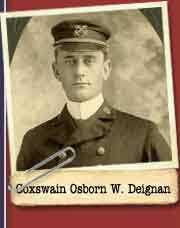
Seaman Osborn Warren Deignan (1873 – 1916)


Osborn Warren Deignan (February 24, 1873 – April 16, 1916) was an enlisted sailor and later a Warrant Officer in the United States Navy. He received his country's highest military decoration—the Medal of Honor—for actions in the Spanish-American War. Born in Iowa, he joined the Navy in 1894 and participated in the Battle of Santiago de Cuba, the largest naval engagement of the Spanish-American war. Deignan and seven others attempted to block the entrance to Santiago Harbor, Cuba but the Spanish destroyed their ship before they could accomplish their mission, and took them prisoner. The men were later released and Deignan received the Medal of Honor for his actions. He went on to become an officer and served in various posts and ships throughout the Navy until retiring in 1906. He died in Colorado in 1916, and was buried in California.
Deignan was born February 24, 1873 (as per first Navy enlistment record dated December 7, 1894) near Stuart, Iowa to John Deignan and his wife. His father had also been a sailor, serving in the Navy during the American Civil War, and afterwards went to work for the Rock Island Railway as a conductor. When Osborn was five years old, a torndado struck his father's train in Grinnel, Iowa, killing him and leaving Osborn, his mother and his brother to survive on their own. His mother remarried and the family, along with two additional children from his new stepfather, moved to North Tremont Street in Stuart. In 1887 he left school and went to sea, serving on ships in the Atlantic ocean, the Arctic and the Caribbean.
Deignan enlisted in the United States Navy from his home state of Iowa, originally on December 7, 1894 (as per first Navy enlistment record). He served on numerous USN vessels between 1894 and 1896 and, having deserted from the USS Newark on May 6, 1896 (as per naval records maintained by the Military Record Center) then re-enlistment in 1898 (as per naval records maintained by the Military Record Center.) He was assigned as a Coxswain to the USS Merrimac (1898) during the Spanish-American War. The Merrimac had frequent problems with the steering and engines, and Deignan referred to it as "cranky". After a short time on the ship, he garnered a reputation as an able helmsman and was preferred when delivering coal to the other ships in the fleet, a task that could be difficult in a ship that was already hard to control.
When Rear Admiral William T. Sampson requested volunteers for an extremely dangerous mission, there were more than enough volunteers, but he chose Osborn as the helmsman. The mission was to sink Merrimac at the entrance to Santiago Harbor, Cuba in an effort to block it and pen the Spanish Navy in the harbor. Seven other members of the crew were also chosen for the assignment. While the crew was attempting to fulfill its mission, Spanish forces fired on the ship and, in the process, disabled the Merrimac's streering controls before the crew could complete their task. The ship sank without obstructing navigation, but the crew was able to escape the ship before she went under. They were rescued by the Spanish and were taken as prisoners-of-war. A month later the Spanish fleet was destroyed at the Battle of Santiago de Cuba and the crewman were released. For his "extraordinary heroism" during the operation, Deignan was awarded the Medal of Honor.
On April 9, 1900, Deignan was promoted to the Warrant Officer rank of Boatswain. As an officer, his initial assignments were in the Philippines, first at Manila, then at the Naval Station, Cavite. After meeting her at a party in 1898, he married Maud Huntoon on May 14, 1902 and together they had a daughter. In June 1902, he reported for duty on the USS Oregon (BB-3) and later that year transferred to the receiving ship USS Independence (1814), at the Mare Island Naval Shipyard, California. He was stationed at Navy Yard, Pensacola, Florida, from 1903 through 1904, and then was assigned to the receiving ship USS Franklin (1864), at Norfolk, Virginia. He remained there for less than a year before reporting for his last tour of duty on the monitor USS Amphitrite (BM-2) in April 1905. He retired on April 21, 1906 and moved to the Los Angeles, California area.
Deignan died April 16, 1916 in Cannon City, Colorado at the age of 43 (based on birth in 1873) and was buried with full military honors at Forest Lawn Memorial Park, Glendale, California. His grave can be found in the Whispering Pines section, L-1165. Post #1842 of the Veterans of Foreign Wars was named in his honor.
Medal of Honor Citation
Rank and organization: Coxswain, U.S. Navy. Born: 24 February 1873, Sheart, Iowa. Accredited to: Iowa. G.O. No.: 529, 2 November 1899. Citation: In connection with the sinking of the U.S.S. Merrimac at the entrance to the harbor of Santiago de Cuba, 2 June 1898. Despite heavy fire from the Spanish batteries, Deignan displayed extraordinary heroism throughout this operation.

Tuesday, November 2, 2010

Woodrow Wilson Keeble (1917 – 1982)


Master Sergeant Woodrow Wilson Keeble (May 16, 1917 - January 28, 1982) was a U.S. Army National Guard veteran of both World War II and the Korean War. He was a full-blooded member of the Sisseton Wahpeton Oyate of the Lake Traverse Reservation, a Sioux Native American tribe.
Following a long campaign by his family and the congressional delegations of both North and South Dakota, on March 3, 2008, President George W. Bush posthumously awarded Keeble the Medal of Honor for his actions in the Korean War. Keeble had previously been awarded the Distinguished Service Cross, the Silver Star, the Bronze Star with V device for Valor, the Bronze Star for merit, and the Combat Infantryman Badge (first and second awards). Although he was wounded at least twice in World War II and three times in Korea, he received only two Purple Hearts.
Woodrow Keeble was born in Waubay, South Dakota to Isaac and Nancy (Shaker) Keeble on May 16, 1917. While still very young, he moved to Wahpeton, North Dakota, where his mother worked at the Wahpeton Indian School (now called Circle of Nations School). Unfortunately, Nancy died when Keeble was still a child. Keeble's father, who was too impoverished to feed his family, permanently enrolled Woodrow and his siblings in the school.
Woodrow excelled in athletics, especially baseball, and pitched the Wahpeton amateur team to ten straight victories. He was being recruited by the Chicago White Sox when his Army National Guard unit was called up to serve in World War II.
In World War II, Keeble served with I Company of the famed North Dakota 164th Infantry Regiment. After initial training in Louisiana, the regiment carried out various orders in several West Coast locations before being deployed to Australia in preparation for operations in the Pacific Theater. Keeble's unit was assigned to the Americal Division.
The 164th landed on Guadalcanal on October 13, 1942 to help the battered First Marine Division, which had suffered heavy losses while clearing the South Pacific island of Japanese. The 164th provided the first replacements for the 1st Marines, and although the new boys were green, the exhausted men heartily welcomed the North Dakotans—and their supplies.
Keeble's regiment of Dakotans was the first United States Army unit to conduct an offensive operation against the enemy in any theater.
Largely because of transport constraints, the Americal Division arrived on Guadalcanal piecemeal, and was fed into combat alongside the battle-hardened Marines. Thus, in contrast to how several US Army divisions were deployed in the Pacific War, the soldiers of the 164th Infantry were able to learn the practical art of jungle warfare against the Japanese without suffering as many casualties as might otherwise have occurred.
The battles on Guadalcanal were some of the most brutal of the war. Japanese troops adopted the Banzai charge, wildly attacking in human waves. Sometimes the hand-to-hand battles would last all through the night.
During these battles, Keeble's reputation for bravery and skill grew. Nearly a head taller than most of his fellow soldiers, he was an expert with the Browning Automatic Rifle (BAR). His other great weapon was his pitching arm, which he used to hurl hand grenades with deadly accuracy. James Fenelon, a member of the Standing Rock Sioux Tribe of North & South Dakota who fought with Keeble on Guadalcanal, once remarked, “The safest place to be was right next to Woody.”
Despite its ad-hoc formation, the Americal Division fought well at Guadalcanal, the 164th taking on a key role in the defeat of a major Japanese offensive in October 1942. Uniquely, the North Dakotans performed so heroically on Guadalcanal in support of the Marines that they received a Navy Presidential Unit Citation.
After the battles on Guadalcanal, Keeble and the rest of the regiment participated in combat campaigns on the islands of Bougainville, Leyte, Cebu, and Mindanao. Following the Japanese surrender, the entire Americal Division landed in Japan and took part in the occupation of the Yokohama region.
After the war, Keeble returned to Wahpeton and worked at the Wahpeton Indian School. On November 14, 1947, Woodrow Wilson Keeble married Nettie Abigail Owen-Robertson (b. March 30, 1917).
Woodrow Keeble on combat
Examining the experience of being in combat for the first time, Keeble explained,
Before I experienced the horror of that attack, I was quick to call coward or yellow anyone who showed fear under any circumstances. Nevermore. I don’t know these things, but they speak truth to one. I am not a psychologist, nor a statistician, and less of a philosopher; but the depth of emotion, the dreads of fear, the referees of horrors, and the concentration of self that led me to make this observation, the fear impulse, or perhaps, better said, the (impulses caused) by fear, are stronger, more demanding than either that of love or hunger...
He also wrote:
Fear in my opinion is a state of drunkenness. And when men are in that state when the fear impulse takes a hold...he loses all reason, sense of values, and is not liable, or at least should not be held accountable for acts perpetrated when thus possessed.
Keeble continued:
During the 13 months (in the) almost continual and sustained combat in which I have ever participated, there were moments, and rare ones, I am sure; but they lose none of their terror or horror for which fear laid a relentless and a powerful hold on me, that the pull of cowardice was almost more than I could ward off. There were terrible moments that encompassed a lifetime, an endlessness, when terror was so strong in me, that I could feel idiocy replace reason. (Yet,) I have never left my position, nor have I shirked hazardous duty. Fear did not make a coward out of me.
The 164th Infantry Regiment was reactivated in 1951 during the Korean War; they trained at Camp Rucker, Alabama. When Keeble's commanding officer, Lt E. Duane Holly, had to select several sergeants for deployment to the front lines, he decided to have his men draw straws. Keeble volunteered instead. Asked why, Keeble said, “Somebody has to teach these kids how to fight.”
Keeble was assigned to George Company, 2nd Battalion, 19th Infantry Regiment, 24th Infantry Division. His combat experience and a genuine gift of leadership brought him a quick series of promotions to the level of master sergeant, leading the 1st Platoon.
The summer and fall of 1951 were particularly deadly for both sides as the war moved into its second year. The 24th Division was in the central area of the Korean peninsula when, on October 13, 1951, the Division was called upon to take a series of steep mountains protecting a major Chinese supply depot in the town of Kumsong.
This push, Operation Nomad-Polar, was to be the last major United Nations offensive of the war.
Keeble, described as a gentle giant by his friends, was a ferocious warrior in battle, as evidenced by his heroic actions over the next six days. Official records confirm Keeble was initially wounded on October 15, and then again on October 17, 18 and 20 - for which he received only one Purple Heart. For his bravery on the 18th, he was awarded a Silver Star. His heroism on the 20th made Keeble a legend - and 57 years later resulted in his posthumous Medal of Honor.
George Company was in its sixth day of round-the-clock fighting. They were facing deeply entrenched Chinese soldiers on Hill 675-770, the last major Chinese stronghold between the UN forces and Kumsong. Keeble had thus far suffered two rifle wounds to his left arm, a grenade to his face that almost removed his nose and a badly twisted knee; on the 19th, doctors reportedly removed 83 pieces of festering shrapnel Keeble had sustained from a concussion grenade the previous day. On the 20th, Medic Dale Selby told Keeble he should stay back because of his wounds, but Keeble refused to let his men go up the mountain without him. That day, Master Sergeant Keeble single-handedly destroyed three enemy machine-gun bunkers and killed an additional seven enemy soldiers in nearby trenches.
His bravery in the face of enemy fire was so remarkable that a recommendation that he receive the Medal of Honor was twice submitted. In both cases, the recommendation was lost. When Keeble's men endeavored to submit the recommendation a third time, officials informed them they were too late; they were told regulations prevented them from submitting another recommendation.
Master Sergeant Keeble returned to North Dakota after the Korean War and again worked at the Wahpeton Indian School. Soon after, he was afflicted with tuberculosis, which required that he undergo long-term treatment in Minneapolis, Minnesota. Surgeons ultimately removed one of his lungs, which triggered a series of strokes that rendered him speechless, partially paralyzed and unable to work for the remainder of his life. Nettie, his wife of 14 years, died the following year, leaving Keeble to raise their young son, Earl, alone.
Keeble fell on hard times and is said to have pawned his medals. Nevertheless, and despite his disabilities, Keeble persevered. In 1967, he married Blossom Iris Crawford-Hawkins (b. July 18, 1926), the first Sioux woman to complete a Doctorate of Education, (including doctoral dissertation).
Woodrow Keeble was a member of the Veterans of Foreign Wars (VFW) Post 4324 - Wahpeton, ND.
Woodrow W. Keeble died January 28, 1982, and is buried in Sisseton, South Dakota. On May 17, 2008, his tombstone was replaced with a Medal of Honor headstone.
Medal of Honor campaign
Keeble's family and friends remained dedicated to efforts to get him the Medal of Honor for which he was twice recommended. United States Senators Byron Dorgan (D-N.D.), Kent Conrad (D-N.D.) John Thune (R-S.D.) and Tim Johnson (D-S.D.) long urged that Keeble be posthumously awarded the Medal of Honor.
Senator Conrad and North Dakota Adjutant General Michael Haugen presented Keeble's family with a duplicate set of his medals on May 30, 2006, at the Wahpeton Armory. Moments before the event was to begin, word came that Secretary of the Army Francis Harvey was recommending Keeble's Distinguished Service Cross be upgraded to the Medal of Honor. From there, Keeble's case moved up to the level of Secretary of Defense.
In 2007, Secretary of Defense Donald Rumsfeld, notified the four Dakota Senators that a statute of limitations would prevent the Medal of Honor to be granted. The four Dakota Senators immediately drafted legislation to remove the last barrier to the posthumous awarding of the honor.
In May 2007, the congressional funding bill for Iraq included language to grant a waiver of the statute of limitations for awarding a Medal of Honor to Woodrow W. Keeble, enabling the President to sign off on the recommendation, dependent on the Secretary of Defense's recommendation for the upgrade. President Bush signed the legislation on May 24, 2007.
Senator Thune issued a statement on June 2 that read, in part,
Master Sergeant Woodrow W. Keeble served with bravery and dignity, going beyond the call of duty not for notoriety or recognition-but for the mission he believed in and the country he loved. Keeble's legacy is a great source of pride for his family, his fellow Dakota Sioux, and all Americans. The Secretary of the Army's recommendation is wonderful and long-awaited news. I began working with Master Sergeant Keeble's family and tribal officials on resolving this long overdue issue in the spring of 2002, and I will continue to work with Defense officials to ensure that this legendary soldier receives the final and most distinguished honor he deserves.
Senator Johnson urged Secretary of Defense Robert M. Gates to act quickly on the recommendation. “... it is my hope that both you and the President can move forward on Master Sergeant Keeble’s case as expeditiously as possible,” Johnson said in a letter to Gates quoted in the Argus Leader of Sioux Falls, South Dakota.
It would be another year before the President would finally award the Medal of Honor to Keeble. Despite failing health, Blossom Keeble was determined to live long enough to accept the Medal of Honor on her husband's behalf. Unfortunately, she died quite suddenly on June 3, 2007 before the honor became a reality.
In February 2008, the White House announced that Keeble would receive the Medal of Honor posthumously in a ceremony scheduled for March 3. "We are just proud to be a part of this for Woody," Keeble's stepson Russell Hawkins said in a U.S. Army announcement. "He is deserving of this, for what he did in the Armed Services in defense of this country."
Hawkins added that this victory is as important for the Sisseton-Wahpeton tribe and North and South Dakota as it is for Keeble and his family. "We are all extremely proud that Woody is finally receiving this honor. He epitomized our cultural values of humility, compassion, bravery, strength and honor."
Hawkins added that Keeble was the embodiment of woyuonihan ("honor"), always carrying himself in a way so that those who knew him would be proud of him. "He lived a life full of honor and respect."
Hawkins said his feelings about Keeble echo those of all who knew him. "If he was alive today, I would tell him there's no one I respect more, and how he is everything a man should be: brave, kind and generous. I would tell him how proud I am of him, and how I never realized that all this time, I was living with such greatness.”
Medal of Honor citation
The President of the United States of America, authorized by Act of Congress, March 3, 2008, has awarded in the name of Congress the Medal of Honor to:
Master Sergeant Woodrow W. Keeble United States Army
For conspicuous gallantry and intrepidity at the risk of his life above and beyond the call of duty: Master Sergeant Woodrow W. Keeble distinguished himself by acts of gallantry and intrepidity above and beyond the call of duty in action with an armed enemy near Sangsan-ni, Korea, on October 20, 1951. On that day, Master Sergeant Keeble was an acting platoon leader for the support platoon in Company G, 19th Infantry, in the attack on Hill 765, a steep and rugged position that was well defended by the enemy. Leading the support platoon, Master Sergeant Keeble saw that the attacking elements had become pinned down on the slope by heavy enemy fire from three well-fortified and strategically placed enemy positions. With complete disregard for his personal safety, Master Sergeant Keeble dashed forward and joined the pinned-down platoon. Then, hugging the ground, Master Sergeant Keeble crawled forward alone until he was in close proximity to one of the hostile machine-gun emplacements. Ignoring the heavy fire that the crew trained on him, Master Sergeant Keeble activated a grenade and threw it with great accuracy, successfully destroying the position. Continuing his one-man assault, he moved to the second enemy position and destroyed it with another grenade. Despite the fact that the enemy troops were now directing their firepower against him and unleashing a shower of grenades in a frantic attempt to stop his advance, he moved forward against the third hostile emplacement, and skillfully neutralized the remaining enemy position. As his comrades moved forward to join him, Master Sergeant Keeble continued to direct accurate fire against nearby trenches, inflicting heavy casualties on the enemy. Inspired by his courage, Company G successfully moved forward and seized its important objective. The extraordinary courage, selfless service, and devotion to duty displayed that day by Master Sergeant Keeble was an inspiration to all around him and reflected great credit upon himself, his unit, and the United States Army.
Monday, November 1, 2010

Thomas Edward McCall (1916 – 1965)


Thomas Edward McCall (May 9, 1916 – September 19, 1965) was a United States Army soldier and a recipient of the United States military's highest decoration—the Medal of Honor—for his actions during the Battle of Monte Cassino in World War II.
McCall joined the Army from Veedersburg, Indiana, and by January 22, 1944 was serving as a Staff Sergeant in Company F, 143rd Infantry Regiment, 36th Infantry Division. On that day, near San Angelo, Italy, he led his section in the crossing of the Rapido River despite intense German fire. After all his men had been killed or wounded, he single-handedly destroyed two enemy machine gun positions and charged a third before being captured. For his actions, he was awarded the Medal of Honor the next year, on April 17, 1945.
McCall died at age 49 and was buried in Spring Vale Cemetery, Lafayette, Indiana.
Medal of Honor citation
Staff Sergeant McCall's official Medal of Honor citation reads:
For conspicuous gallantry and intrepidity at risk of life above and beyond the call of duty. On 22 January 1944, Company F had the mission of crossing the Rapido River in the vicinity of San Angelo, Italy, and attacking the well-prepared German positions to the west. For the defense of these positions the enemy had prepared a network of machinegun positions covering the terrain to the front with a pattern of withering machinegun fire, and mortar and artillery positions zeroed in on the defilade areas. S/Sgt. McCall commanded a machinegun section that was to provide added fire support for the riflemen. Under cover of darkness, Company F advanced to the river crossing site and under intense enemy mortar, artillery, and machinegun fire crossed an ice-covered bridge which was continually the target for enemy fire. Many casualties occurred on reaching the west side of the river and reorganization was imperative. Exposing himself to the deadly enemy machinegun and small arms fire that swept over the flat terrain, S/Sgt. McCall, with unusual calmness, encouraged and welded his men into an effective fighting unit. He then led them forward across the muddy, exposed terrain. Skillfully he guided his men through a barbed-wire entanglement to reach a road where he personally placed the weapons of his two squads into positions of vantage, covering the battalion's front. A shell landed near one of the positions, wounding the gunner, killing the assistant gunner, and destroying the weapon. Even though enemy shells were falling dangerously near, S/Sgt. McCall crawled across the treacherous terrain and rendered first aid to the wounded man, dragging him into a position of cover with the help of another man. The gunners of the second machinegun had been wounded from the fragments of an enemy shell, leaving S/Sgt. McCall the only remaining member of his machinegun section. Displaying outstanding aggressiveness, he ran forward with the weapon on his hip, reaching a point 30 yards from the enemy, where he fired 2 bursts of fire into the nest, killing or wounding all of the crew and putting the gun out of action. A second machinegun now opened fire upon him and he rushed its position, firing his weapon from the hip, killing 4 of the guncrew. A third machinegun, 50 yards in rear of the first two, was delivering a tremendous volume of fire upon our troops. S/Sgt. McCall spotted its position and valiantly went toward it in the face of overwhelming enemy fire. He was last seen courageously moving forward on the enemy position, firing his machinegun from his hip. S/Sgt. McCall's intrepidity and unhesitating willingness to sacrifice his life exemplify the highest traditions of the Armed Forces.

Vernon McGarity (1921- )


Vernon McGarity (born December 1, 1921) is a former United States Army soldier and a recipient of the U.S. military's highest decoration, Medal of Honor, for his actions during the Battle of the Bulge in World War II.
Born in Right, Tennessee, on December 1, 1921, McGarity joined the Army from Model, Tennessee. By December 16, 1944, the first day of the Battle of the Bulge, he was serving near Krinkelt, Belgium, as a technical sergeant in Company L of the 393rd Infantry Regiment, 99th Infantry Division. Wounded early in the battle, McGarity returned to his unit and, as squad leader, directed and encouraged his soldiers throughout the intense fight which ensued. He repeatedly braved heavy fire to rescue wounded men, attack the advancing Germans, and retrieve supplies. Only after completely running out of ammunition were he and his squad captured. For his actions during the battle, he was awarded the Medal of Honor a year later, on January 11, 1946.
Medal of Honor citation
He was painfully wounded in an artillery barrage that preceded the powerful counteroffensive launched by the Germans near Krinkelt, Belgium, on the morning of 16 December 1944. He made his way to an aid station, received treatment, and then refused to be evacuated, choosing to return to his hard-pressed men instead. The fury of the enemy's great Western Front offensive swirled about the position held by T/Sgt. McGarity's small force, but so tenaciously did these men fight on orders to stand firm at all costs that they could not be dislodged despite murderous enemy fire and the breakdown of their communications. During the day the heroic squad leader rescued 1 of his friends who had been wounded in a forward position, and throughout the night he exhorted his comrades to repulse the enemy's attempts at infiltration. When morning came and the Germans attacked with tanks and infantry, he braved heavy fire to run to an advantageous position where he immobilized the enemy's lead tank with a round from a rocket launcher. Fire from his squad drove the attacking infantrymen back, and 3 supporting tanks withdrew. He rescued, under heavy fire, another wounded American, and then directed devastating fire on a light cannon which had been brought up by the hostile troops to clear resistance from the area. When ammunition began to run low, T/Sgt. McGarity, remembering an old ammunition hole about 100 yards distant in the general direction of the enemy, braved a concentration of hostile fire to replenish his unit's supply. By circuitous route the enemy managed to emplace a machinegun to the rear and flank of the squad's position, cutting off the only escape route. Unhesitatingly, the gallant soldier took it upon himself to destroy this menace single-handedly. He left cover, and while under steady fire from the enemy, killed or wounded all the hostile gunners with deadly accurate rifle fire and prevented all attempts to re-man the gun. Only when the squad's last round had been fired was the enemy able to advance and capture the intrepid leader and his men. The extraordinary bravery and extreme devotion to duty of T/Sgt. McGarity supported a remarkable delaying action which provided the time necessary for assembling reserves and forming a line against which the German striking power was shattered.

William J. "Bill" Crawford (1918 – 2000)


William J. "Bill" Crawford (May 19, 1918 – March 15, 2000) was a United States Army soldier who received the Medal of Honor for his actions during World War II.
Crawford was born on May 19, 1918, in Pueblo, Colorado, and later joined the U.S. Army from that city. By September 13, 1943, he was serving as a private with the 36th Infantry Division in southern Italy. On that day, he was acting as a squad scout when his company attacked Hill 424 near Altavilla Silentina. During the battle, Crawford twice moved forward through continuous fire and, using hand grenades and his rifle, destroyed machine gun nests which were holding back his platoon's advance.
After the battle, Crawford was captured by the Germans and presumed dead. So in 1945, the Medal of Honor was presented to his father. Later in the year, Crawford was among a group of soldiers rescued from German captivity.
On January 13, 1946, he married Eileen Bruce. He retired from the Army after 23 years of service and later worked at the United States Air Force Academy in Colorado Springs and as director of the Lucretia Vaille Museum in Palmer Lake.
While working at the Air Force Academy, he mentioned to friends that he had never received the Medal from the president. In 1984, during that year's graduation ceremony, President Ronald Reagan formally presented him with the Medal.
Crawford died at age 81 on March 15, 2000, in his residence at Palmer Lake. Upon his death Governor Bill Owens authorized all Colorado flags to be lowered to half staff in his honor. He is buried at the United States Air Force Academy Cemetery in Colorado Springs.
He is one of four Medal of Honor recipients from Pueblo, Colorado, the others being Drew Dennis Dix, Raymond G. Murphy, and Carl L. Sitter.
Medal of Honor citation
For conspicuous gallantry and intrepidity at risk of life above and beyond the call of duty in action with the enemy near Altavilla, Italy, 13 September 1943. When Company I attacked an enemy-held position on Hill 424, the 3d Platoon, in which Pvt. Crawford was a squad scout, attacked as base platoon for the company. After reaching the crest of the hill, the platoon was pinned down by intense enemy machinegun and small-arms fire. Locating 1 of these guns, which was dug in on a terrace on his immediate front, Pvt. Crawford, without orders and on his own initiative, moved over the hill under enemy fire to a point within a few yards of the gun emplacement and single-handedly destroyed the machinegun and killed 3 of the crew with a hand grenade, thus enabling his platoon to continue its advance. When the platoon, after reaching the crest, was once more delayed by enemy fire, Pvt. Crawford again, in the face of intense fire, advanced directly to the front midway between 2 hostile machinegun nests located on a higher terrace and emplaced in a small ravine. Moving first to the left, with a hand grenade he destroyed 1 gun emplacement and killed the crew; he then worked his way, under continuous fire, to the other and with 1 grenade and the use of his rifle, killed 1 enemy and forced the remainder to flee. Seizing the enemy machinegun, he fired on the withdrawing Germans and facilitated his company's advance.

Russell Dunham (1920 – 2009)


Russell Dunham (February 23, 1920 – April 6, 2009) was an American World War II veteran and recipient of the Medal of Honor. On January 8, 1945, as a member of Company I, 30th Infantry, 3d Infantry Division, Dunham eliminated three German machine gun nests despite being injured himself. Dunham and his brother Ralph, who also joined the United States Army, grew up on a farm in Fosterburg, Illinois.
Combat action on January 8, 1945
Dunham was a platoon leader in his unit. Dunham's unit became pinned down at the base of snow-covered Hill 616, a steep hill in Alsace-Lorraine near Kaysersberg, France on January 8, 1945. With machine gun fire coming down the hill in front of their unit, and a heavy artillery barrage landing behind them, Dunham decided "the only way to go was up". Using a white mattress cover as a camouflage aid against the backdrop of the snow, Dunham began moving up the hill. He carried with him a dozen hand grenades and a dozen magazines for his M1 Carbine.
Dunham began crawling more than 100 yards (91 m) to the first machine gun nest under fire from two machine guns and supporting riflemen. When 10 yards (9 m) from the nest, he jumped up to assault the nest and was hit by a bullet which caused him to tumble 15 yards (14 m) downhill. He got back up and charged the nest firing his carbine as he went, and kicked aside an egg grenade that had landed at his feet. Prior to reaching the nest, he tossed a hand grenade into the nest. When he got to the nest, he killed the machine gunner and his assistant. His carbine then jammed, and he jumped into the machine gun emplacement. He threw a third German in the nest down the hill who was later captured by his unit.
With his carbine jammed, he picked up another carbine from a wounded soldier and advanced on the second nest, 50 yards (46 m) away. As he came within 25 yards (23 m) of the nest, he lobbed two hand grenades into the nest, wiping it out. He followed this up by firing down fox holes used in support of the nest. He then began his slow advance on the third nest, 65 yards (59 m) up the hill. He made his advance on the third nest under heavy automatic fire and grenades. As he came within 15 yards (14 m) of the nest, he tossed more grenades and wiped out the last nest, barely being missed at point blank range by a German rifleman.
During the action, Dunham killed nine Germans, wounded seven and captured two on his own. Nearly 30 other Germans were captured as a result of his actions.
When Dunham was presented with the Medal of Honor, General Alexander Patch said as he placed the award around Dunham's neck that his actions in single-handedly destroying the machine gun nests saved the lives of 120 U.S. soldiers who had been pinned down.
For his injuries on that day, Dunham also received the Purple Heart. Shrapnel from his injuries remained in his body for the rest of his life, and Dunham was quoted as saying "The shrapnel in my leg is a reminder of the war we fought."
Dunham returned to the front before his wounds healed. On January 22 his battalion was surrounded by tanks, forcing most of the men to surrender. The following morning, two German soldiers discovered Dunham hiding in a sauerkraut barrel outside a barn. When their search of his pockets turned up a pack of cigarettes, they fought over it, overlooking his pistol in a shoulder holster. Later that day as he was being transported toward German lines, the driver stopped in a bar, giving Dunham the opportunity to shoot his other captor in the head and set off toward the American lines. Dunham suffered severe frostbite while completing his escape.
Medal of Honor citation
Rank: Technical Sergeant, U.S. Army Organization: Company I, 30th Infantry, 3d Infantry Division. Place: Near Kaysersberg, France, Date: 8 January 1945. Entered service at: Brighton, Illinois Order: G.O. No.: 37, 11 May 1945.
Citation:
For conspicuous gallantry and intrepidity at risk of life above and beyond the call of duty. At about 1430 hours on 8 January 1945, during an attack on Hill 616, near Kayserberg, France, T/Sgt. Dunham single-handedly assaulted 3 enemy machine guns. Wearing a white robe made of a mattress cover, carrying 12 carbine magazines and with a dozen hand grenades snagged in his belt, suspenders, and buttonholes, T/Sgt. Dunham advanced in the attack up a snow-covered hill under fire from 2 machine guns and supporting riflemen. His platoon 35 yards behind him, T/Sgt. Dunham crawled 75 yards under heavy direct fire toward the timbered emplacement shielding the left machine gun. As he jumped to his feet 10 yards from the gun and charged forward, machine gun fire tore through his camouflage robe and a rifle bullet seared a 10-inch gash across his back sending him spinning 15 yards down hill into the snow. When the indomitable sergeant sprang to his feet to renew his 1-man assault, a German egg grenade landed beside him. He kicked it aside, and as it exploded 5 yards away, shot and killed the German machine gunner and assistant gunner. His carbine empty, he jumped into the emplacement and hauled out the third member of the gun crew by the collar. Although his back wound was causing him excruciating pain and blood was seeping through his white coat, T/Sgt. Dunham proceeded 50 yards through a storm of automatic and rifle fire to attack the second machine gun. Twenty-five yards from the emplacement he hurled 2 grenades, destroying the gun and its crew; then fired down into the supporting foxholes with his carbine dispatching and dispersing the enemy riflemen. Although his coat was so thoroughly blood-soaked that he was a conspicuous target against the white landscape, T/Sgt. Dunham again advanced ahead of his platoon in an assault on enemy positions farther up the hill. Coming under machinegun fire from 65 yards to his front, while rifle grenades exploded 10 yards from his position, he hit the ground and crawled forward. At 15 yards range, he jumped to his feet, staggered a few paces toward the timbered machinegun emplacement and killed the crew with hand grenades. An enemy rifleman fired at pointblank range, but missed him. After killing the rifleman, T/Sgt. Dunham drove others from their foxholes with grenades and carbine fire. Killing 9 Germans—wounding 7 and capturing 2—firing about 175 rounds of carbine ammunition, and expending 11 grenades, T/Sgt. Dunham, despite a painful wound, spearheaded a spectacular and successful diversionary attack.

Friday, October 29, 2010

Jose C. Calugas, Sr (1907 – 1998)


Jose Calugas (December 29, 1907 – January 18, 1998) was a member of the Philippine Scouts during World War II. He received the Medal of Honor for actions during the Battle of Bataan.

At the age of 23, Calugas joined the Philippine Scouts of the United States Army and completed training as an artilleryman and served with different artillery batteries of the Philippine Scouts until his unit was mobilized to fight in World War II. After noticing one of his unit's gun batteries had been destroyed and its crew killed, he gathered several members of his unit together, dug in and attempted to defend the line. He was captured along with other members of his unit and forced to march to a distant enemy prison camp, where he was held as a prisoner of war. When he was released in 1943, he was secretly assigned to a guerilla unit the Philippines where he fought for the liberation of the Philippines from the Japanese.
After retiring from the Army he settled in Tacoma, Washington and became a United States citizen.

Calugas was born in Barrio Tagsing, Leon, Iloilo, Philippines, December 29, 1907. In 1930, he enlisted in the United States Army and had received his basic training at Fort Sill, Oklahoma. Upon completion, he received additional training as an artilleryman, and then assigned to the 24th Artillery Regiment of the Philippine Scouts at Fort Stotsenburg, Pampanga. While stationed at Fort Stotsenburg, he married and began to raise a family. His next unit was the 88th Field Artillery Regiment of the Philippine Scouts. He was a Sergeant with Battery B when the United States and the Philippine Commonwealth, declared war with Japan in 1941. His unit was mobilized for duty and sent to Bataan in December 1941.

On January 6, 1942, his unit was covering the withdrawal of a portion of the U.S. Army Forces, Far East (USAFFE), with the 26th Cavalry Regiment of the Philippine Scouts and the 31st Infantry Regiment. Calugas was working as a mess sergeant in charge of a group of soldiers who were preparing the day's meals, known as KP duty. He noticed that one of his unit's guns had been silenced, and its crew killed. Without orders, he ran the 1,000 yards (914 m) across the shell-swept area to the inactive gun position. Once there, he organized a squad of volunteers who returned Japanese artillery fire. The position remained under constant and heavy fire for the rest of the afternoon. While Calugas and his squad maintained a steady fire on the enemy positions, other soldiers had time to dig in and defend the line. As the day ended and combat subsided, he returned to KP. For his actions on that day, his superiors recommended Calugas for the United States military's highest decoration for valor, the Medal of Honor. Before he could receive it, however, all American forces on Bataan surrendered to Japanese forces.

Arguably, the Battle of Bataan represented the most intense phase of Imperial Japan's invasion of the Philippines during World War II. During the final stage of the Battle of Bataan and after repeated assaults and artillery fire by Japanese forces, the communications and defenses of the allies on Bataan peninsula had been almost completely destroyed. On the last two days, the entire Allied defense collapsed, clogging all roads with refugees and fleeing troops. By April 8, the senior U.S. commander on Bataan, Major General Edward "Ned" P. King, Jr., recognized the futility of further resistance, and explored proposals for capitulation. On April 9, 1942, approximately 76,000 Filipino and American troops surrendered to a Japanese army of 54,000 men under Lt. General Masaharu Homma. This was the single largest surrender of one of its military forces in American history.

Route of the Bataan Death March. The section from San Fernando to Capas was by rail. Then they marched 8 miles to Camp O'Donnell.

After the surrender, Calugas and the other prisoners marched from Mariveles to Camp O'Donnell, a prison camp in the province of Tarlac. The Japanese, having expected the fighting to continue, anticipated about 25,000 prisoners of war and were inadequately prepared or unwilling to transport a group of prisoners three times the size. The majority of the POW’s, were immediately relieved of their belongings and endured a 61-mile (98 km) march in deep dust, over vehicle-broken macadam roads, and crammed into rail cars for the portion of the journey from San Fernando to Capas. Enroute, over 21,000 men and women died from disease, starvation, dehydration, heat prostration, untreated wounds, and wanton execution. The deaths of Filipinos to Americans, was disproportionately high: approximately 5,000–10,000 Filipino and 600–650 American prisoners of war died on the Bataan Death March. Calugas remained a prisoner at Camp O'Donnell until January 1943, when he was released to work for the Japanese.

His release placed him as a laborer in a Japanese rice mill, and while assigned there he secretly joined a guerrilla unit, #227 Old Bronco. As an officer of the guerrilla unit, he participated in the attack on the Japanese garrison at Karangalan. His unit fought in the continued campaign against the Japanese, which eventually led to the liberation of the Philippines.

After the liberation of the Philippines in 1945, he finally received the Medal of Honor for which he had been approved the beginning of the war. The Medal was presented to him by General of the Army General George Marshall. Calugas subsequently accepted a direct commission in the United States Army, and was later assigned to the 44th Infantry Regiment, which was assigned with the occupation of Okinawa. After the unit was disbanded in 1947, he was assigned to the Ryuku Command, on the Ryukyu Islands in the South China Sea, where he remained until 1953.
Although he had been born in a U.S. territory, and had fought in the United States' Army, Calugas technically was not a citizen. Following the Spanish American War in 1898, Philippine residents were classified as U.S. nationals. The 1934 Tydings-McDuffie Act, or Philippine Independence Act, reclassified Filipinos as aliens, and set a quota of 50 immigrants per year to the United States, with the exception of those who joined the U.S. Navy, but not the U.S. Army. While serving in Okinawa, Calugas completed the process of becoming a naturalized United States citizen.
Calugas, eventually retired from the army with the rank of Captain, and in 1957, he moved to in Tacoma, Washington with his family. After retiring from the army he earned a degree in Business Administration from the University of Puget Sound in 1961and worked for the Boeing Corporation. In addition to furthering his education and starting a new career, he was involved in several veterans groups within the Seattle and Tacoma area. He died in Tacoma on January 18, 1998 at age 90 and is buried at Mountain View Memorial Park in Tacoma, Washington.

Medal of Honor citation

Rank and organization: Sergeant, U.S. Army, Battery B, 88th Field Artillery, Philippine Scouts. Place and date: At Culis, Bataan Province, Philippine Islands, 16 January 1942. Entered service at: Fort Stotsenburg, Philippine Islands. Born: 29 December 1907, Barrio Tagsing, Leon, %Iloilo, Philippine Islands. G.O. No.: 10, 24 February 1942. Citation: The action for which the award was made took place near Culis, Bataan Province, Philippine Islands, on 16 January 1942. A battery gun position was bombed and shelled by the enemy until 1 gun was put out of commission and all the cannoneers were killed or wounded. Sgt. Calugas, a mess sergeant of another battery, voluntarily and without orders ran 1,000 yards across the shell-swept area to the gun position. There he organized a volunteer squad which placed the gun back in commission and fired effectively against the enemy, although the position remained under constant and heavy Japanese artillery fire.

Thursday, October 28, 2010

Colonel George Everette "Bud" Day


Colonel Bud Day - Ex-POW & Recipient of the Medal of Honor - On Torture
"I didn't expect to be reminded of my treatment some 36 years ago on this holiday weekend but our politicians find it worthy to ignore what some have tried to recount to them, who have actually been there."

I was shot down over North Vietnam in 1967...a squadron commander.

After I returned in 1973, I published two books that dealt a lot with "real torture" in Hanoi. Our make believe president is branding our country as a bunch of torturers when he has no idea what torture is.

As for me..put thru a mock execution because I would not respond...pistol whipped on the head...same event. Couple of days later...hung by my feet all day. I escaped and got recaptured a couple of weeks later...I got shot and recaptured. Shot was okay...what happened after was not.

They marched me to Vinh...put me in the rope trick, trick...almost pulled my arms out of the sockets. Beat me on the head with a little wooden rod until my eyes were swelled shut, and my unshot, unbroken hand a pulp.

Next day hung me by the arms...rebroke my right wrist...wiped out the nerves in my arms that control the hands..rolled my fingers up into a ball. Only left the slightest movement of my left forefinger. So I started answering with some incredible lies.

Sent me to Hanoi strapped to a barrel of gas in the back of a truck.

Hanoi...on my knees...rope trick again. Beaten by a big fool.

Into leg irons on a bed in Heartbreak Hotel.

Much kneeling--hands up at Zoo.

Really bad beating for refusing to condemn Lyndon Johnson.

Several more kneeling events. I could see my knee bone thru kneeling holes.

There was an escape from the annex to the Zoo. I was the Senior Officer of a large building because of escape...they started a mass torture of all commanders.

I think it was July 7, 1969...they started beating me with a car fan belt. In first two days I took over 300 strokes...then stopped counting because I never thought I would live thru it.

They continued day-night torture to get me to confess to a non-existent part in the escape. This went on for at least 3 days. On my knees...fan belting...cut open my scrotum with fan belt stroke...opened up both knee holes again. My fanny looked like hamburger...I could not lie on my back.

They tortured me into admitting that I was in on the escape...and that my two room-mates knew about it.

The next day I denied the lie.

They commenced torturing me again with 3, 6, or 9 strokes of the fan belt every day from about July 11 or 12th...to 14 October 1969. I continued to refuse to lie about my roommates again.

Now, the point of this is that our make-believe president has declared to the world that we ( U.S. ) are a bunch of torturers. Thus it will be okay to torture us next time when they catch us...because that is what the U.S. does.

Our make-believe president is a know nothing fool who thinks that pouring a little water on some one's face, or hanging a pair of womens pants over an Arabs head is TORTURE. He is a meathead.

I just talked to MOH holder Leo Thorsness who was also in my squad in jail...as was John McCain...and we agree that McCain does not speak for the POW group when he claims that Al Gharib was torture...or that "water boarding" is torture.

Our president and those fools around him who keep bad mouthing our great country are a disgrace to the United States. Please pass this info on to Sean Hannity. He is free to use it to point out the stupidity of the claims that water boarding...which has no after effect...is torture. If it got the Arab to cough up the story about how he planned the attack on the twin towers in NYC...hurrah for the guy who poured the water.


George Everette "Bud" Day (born February 24, 1925) is a retired U.S. Air Force Colonel and Command Pilot who served during the Vietnam War, to include five years and seven months as a Prisoner of War in North Vietnam. He is often cited as being the most decorated U.S. service member since General Douglas MacArthur, having received some seventy decorations, a majority for actions in combat. Day is a recipient of the Medal of Honor.
Day was born in Sioux City, Iowa, on February 24, 1925. In 1942 he quit high school and enlisted in the United States Marine Corps. He served 30 months in the North Pacific during World War II as a member of a 5 in (130 mm) gun battery with the 3rd Defense Battalion on Johnston Island.
After the war, Day attended Morningside College on the G.I. Bill, earning a Bachelor of Science Degree, followed by law school at the University of South Dakota, receiving a Juris Doctor. Day passed the bar exam in 1949 and was admitted to the bar in South Dakota. In later life, Day was also awarded a Master of Arts degree from St. Louis University, a Doctor of Humane Letters from Morningside, and a Doctor of Laws from Troy State University. Day was admitted to the Florida Bar in 1977.
A member of the Army Reserve, in 1950 he received a direct commission as a Second Lieutenant in the Iowa Air National Guard, and was called to active duty in 1951 for Undergraduate Pilot Training in the U.S. Air Force. He served two tours as a fighter-bomber pilot during the Korean War flying the Republic F-84 Thunderjet, surviving a "no-chute" ejection in 1955. Promoted to captain, he decided to make the Air Force a career and was augmented into the Regular Air Force. He then transitioned to the F-100 Super Sabre in 1957 while stationed at RAF Wethersfield.
Anticipating retirement in 1968 and now a major, Day volunteered for a tour in Vietnam and was assigned to the 31st Tactical Fighter Wing at Tuy Hoa Air Base in April 1967. At that time he had more than 5,000 flying hours, with 4,500 of them in fighters. On June 25, 1967, with extensive previous service flying two tours in F-100s, Major Day was made the first commander of Detachment 1, 416th Tactical Fighter Squadron, 37th Tactical Fighter Wing based at Phu Cat Air Base. Under the project name "Commando Sabre", twin-seat USAF F-100Fs were evaluated as a Fast Forward Air Control ("Fast FAC") aircraft in high threat areas, given that F-4 Phantom II aircraft were in high demand for strike and Combat Air Patrol (CAP) roles. Using the call sign Misty, the name of Day's favorite song, his detachment of four two-seat F-100Fs and 16 pilots became pioneer "Fast FACs" (Forward Air Controllers) over Laos and North Vietnam. All Misty FAC crews were volunteers with at least 100 combat missions in Vietnam and 1,000 minimum flight hours. Tours in Commando Sabre were temporary and normally limited to four months or about 50-60 missions.

Prisoner of war
On August 26, 1967, Major Day was flying F-100F-15-NA, AF Serial No. 56-3954, call sign "Misty 01", on his 26th Fast FAC sortie, directing a flight of F-105 Thunderchiefs in an air strike against a surface-to-air missile (SAM) site north of Thon Cam Son and west of Dong Hoi, 20 mi (32 km) north of the DMZ in North Vietnam. Day was on his 65th mission into North Vietnam and acting as check pilot for Captain Corwin M. "Kipp" Kippenhan, who was upgrading to aircraft commander. 37 mm antiaircraft fire crippled the aircraft, forcing the crew to eject. In the ejection, Day's right arm was broken in three places when he struck the side of the cockpit, and he also experienced eye and back injuries.
Kippenhan was rescued by a USAF HH-3E, but Day was unable to contact the rescue helicopter by survival radio and was quickly captured by North Vietnamese local militia. On his fifth night, when he was still within 20 mi (32 km) of the DMZ, Day escaped from his initial captors despite his serious injuries. Although stripped of both his boots and flight suit, Day crossed the Demilitarized Zone back into South Vietnam, becoming the only U.S. prisoner of war to escape from North Vietnam. Within 2 mi (3 km) of the U.S. Marine firebase at Con Thien and after 12–15 days of evading, he was captured again, this time by a Viet Cong patrol that wounded him in the leg and hand with gunfire.
Taken back to his original camp, Day was tortured for escaping, breaking his right arm again. He then was moved to several prison camps near Hanoi, where he was periodically beaten, starved, and tortured. In December 1967, Day shared a cell with Navy Lieutenant Commander and future Senator and Presidential Candidate John McCain who was even more seriously injured and emaciated. Air Force Major Norris Overly nursed both back to health, and McCain later devised a makeshift splint of bamboo and rags that helped heal Day's seriously atrophied arm.[4]
On March 14, 1973, Day was released after five years and seven months as a North Vietnamese prisoner. Within three days Day was reunited with his wife, Doris Sorensen Day, and four children at March Air Force Base, California. On March 4, 1976, President Gerald Ford awarded Day the Medal of Honor for his personal bravery while a captive in North Vietnam.
Day had been promoted to Colonel while a prisoner, and decided to remain in the Air Force in hopes of being promoted to Brigadier General. Although initially too weak to resume operational flying, he spent a year in physical rehabilitation and with 13 separate medical waivers, was returned to active flying status. He underwent conversion training to the F-4 Phantom II and was appointed vice commander of the 33rd Tactical Fighter Wing at Eglin Air Force Base, Florida.

Retirement
After being passed over for nomination to brigadier general, Day retired from active duty in 1977 to resume his practice of law in Florida. At his retirement he had nearly 8,000 total flying hours, 4,900 in single engine jets, and had flown the F-80 Shooting Star, F-84 Thunderjet, F-100 Super Sabre, F-101 Voodoo, F-104 Starfighter, F-105 Thunderchief, F-106 Delta Dart, F-4 Phantom II, A-4 Skyhawk, A-7 Corsair II, CF-5 Tiger, F-15 Eagle jet fighters.
Following his retirement, Day wrote an autobiographical account of his experiences as a prisoner of war, Return with Honor, followed by Duty, Honor, Country, which updated his autobiography to include his post-Air Force years. Among other endeavors, in 1996 Day filed a class action lawsuit for breach of contract against the United States government on behalf of military retirees who were stripped of their military medical care benefits at age 65 and told to apply for Medicare. Although winning the case in the district court in 2001, the judgment against the U.S. was overturned by the U.S. Court of Appeals in 2002. The U.S. Congress later redressed this situation by establishing the "TRICARE For Life" (TFL) program, which restored TRICARE military medical benefits for career military retirees over the age of 65, making the retirees eligible for both programs with Medicare as the primary payer and TRICARE as the secondary payer.

Political activity and controversy
Day is an active member of the Florida Republican Party, was involved in the 527 group Swift Vets and POWs for Truth, and campaigned with John McCain in 2000 and 2008. In the months leading up to the 2004 U.S. presidential election, Day appeared in television advertisements—along with other members of the 527 group Swift Vets and POWs for Truth—decrying John Kerry's anti-war activities following his military service during the Vietnam War and declaring him "unfit" for service and of a "dishonest" disposition for comments and actions made by Kerry after the Vietnam War, including his testimony at the Winter Soldier Conference in Washington, D.C. During a 2008 teleconference with reporters from the Miami Herald, Day made comments regarding John McCain's stance on the Iraq War, stating that "I don't intend to kneel, and I don't advocate to anybody that we kneel, and John [McCain] doesn't advocate to anybody that we kneel." Also during this interview he sparked controversy by making a broad generalization about what some see as an ideological divide between Islam and America: "the Muslims have said either we kneel, or they're going to kill us." In the same interview when questioned about the role of 527 organizations in contemporary American politics, particularly his work for the Swift Boat Veterans for Truth, Day stated "the bottom line is this: 527 groups can do very effective, truthful things, and the Swift Boat attack was totally truthful."

Awards and decorations
Medal of Honor, Air Force Cross, Distinguished Service Medal, Silver Star, Legion of Merit, Distinguished Flying Cross, Bronze Star with Combat "V" for Valor and three Oak Leaf Clusters (three Bronze Star Medals for "Valor" and one Bronze Star Medal), Defense Meritorious Service Medal, Air Medal with nine Oak Leaf Clusters, Purple Heart with three Oak Leaf Clusters, Prisoner of War Medal, Presidential Unit Citation (three awards), Air Force Outstanding Unit Award with Combat "V" for Valor (four awards), Combat Readiness Medal, Marine Corps Good Conduct Medal, Army Good Conduct Medal, American Campaign Medal, Asiatic-Pacific Campaign Medal, World War II Victory Medal, National Defense Service Medal (2 awards), Korean Service Medal, Vietnam Service Medal with 14 campaign stars, Air Force Longevity Service Award, 5 oak leaf clusters, Armed Forces Reserve Medal, Small Arms Expert Marksmanship Medal, National Order of Vietnam, United Nations Service Medal, Vietnam Gallantry Cross with Palm (individual award), Vietnam Gallantry Cross (unit citation), Republic of Vietnam Campaign Medal

Air Force Cross citation
The Air Force Cross is presented to George Everett Day, Colonel, United States Air Force, for extraordinary heroism in military operations against an opposing armed force as a Prisoner of War in North Vietnam from 16 July 1969 to 14 October 1969. During this period, Colonel Day was subjected to maximum punishment and torture by Vietnamese guards to obtain a detailed confession of escape plans, policies, and orders of the American senior ranking officer in the camp, and the communications methods used by the Americans interned in the camp. Colonel Day withstood this punishment and gave nothing of value to the Vietnamese, although he sustained many injuries and open wounds to his body. Through his extraordinary heroism and willpower, in the face of the enemy, Colonel Day reflected the highest credit upon himself and the United States Air Force.

Medal of Honor citation
Citation: On 26 August 1967, Col. Day was forced to eject from his aircraft over North Vietnam when it was hit by ground fire. His right arm was broken in 3 places, and his left knee was badly sprained. He was immediately captured by hostile forces and taken to a prison camp where he was interrogated and severely tortured. After causing the guards to relax their vigilance, Col. Day escaped into the jungle and began the trek toward South Vietnam. Despite injuries inflicted by fragments of a bomb or rocket, he continued southward surviving only on a few berries and uncooked frogs. He successfully evaded enemy patrols and reached the Ben Hai River, where he encountered U.S. artillery barrages. With the aid of a bamboo log float, Col. Day swam across the river and entered the demilitarized zone. Due to delirium, he lost his sense of direction and wandered aimlessly for several days. After several unsuccessful attempts to signal U.S. aircraft, he was ambushed and recaptured by the Viet Cong, sustaining gunshot wounds to his left hand and thigh. He was returned to the prison from which he had escaped and later was moved to Hanoi after giving his captors false information to questions put before him. Physically, Col. Day was totally debilitated and unable to perform even the simplest task for himself. Despite his many injuries, he continued to offer maximum resistance. His personal bravery in the face of deadly enemy pressure was significant in saving the lives of fellow aviators who were still flying against the enemy. Col. Day's conspicuous gallantry and intrepidity at the risk of his life above and beyond the call of duty are in keeping with the highest traditions of the U.S. Air Force and reflect great credit upon himself and the U.S. Armed Forces.